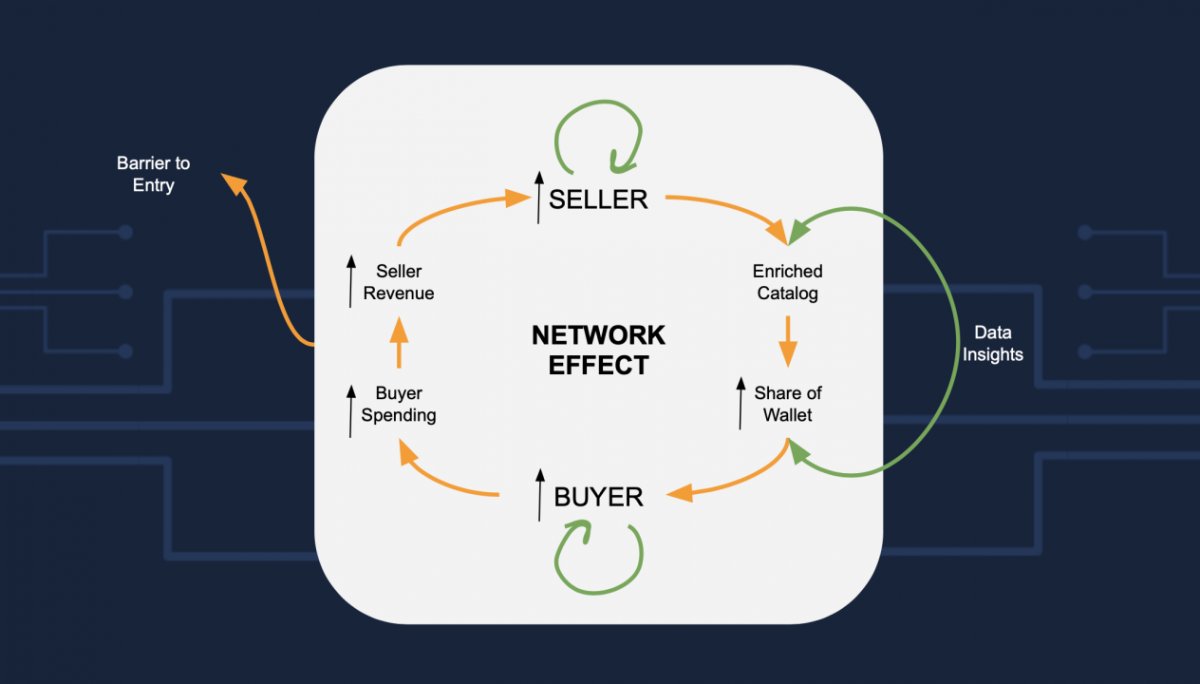

This article was developed by ThinkZone based on the blog content of Tanay Jaipuria, analyze the mechanism of Network Effect by dividing this effect into component effects, and how to create Network Effect for products.
* The article uses many English terms because there are no equivalent terms in Vietnamese.
-----
Sign up for ThinkZone's weekly newsletter to not miss the latest blog posts and investment news: https://bit.ly/TZNewsletter_web
-----
WHAT IS NETWORK EFFECT?
Simply put, Network Effect occurs when the value of a product or service increases when more users use that product/service.
Some direct examples of such products/services include: Social networks (Facebook, Twitter,...), Connection platforms (ride-hailing - Grab, Uber; delivery - Ahamove, GHN; finding friends - Tinder,...), mobile networks (Viettel, Vinaphone,...).

This article will delve into how to create a Network Effect for a product/service by breaking this concept into smaller sub-effects, including:
➤ Acquisition Effect: Helps the product grow users more easily as the number of users increases → The more users, the easier it is for the product to acquire more users.
➤ Engagement Effect: Helps users interact with the product more as the number of users increases → The more users, the more users interact with the product.
➤ Economic Effect: Helps the product earn better revenue as the number of users increases → The more users, the higher the revenue.
This subdivision will help us see Network Effect as 3 sub-components, each targeting a specific goal of the company, thereby making it easier to analyze and build a product development strategy.
Now let's go into each of these component effects!
I. ACQUISITION EFFECT
As mentioned above, Acquisition Effect is an effect that appears when the number of users of a product increases, the easier it is for the company to acquire new users, which means Customer Acquisition Cost (CAC) reduce.
The best way to measure Acquisition Effect is through the percentage of organic user growth (organic growth) and CAC. If over time, the percentage of organic user growth increases accompanied by a decrease in CAC, it is a sign that the product has created an Acquisition Effect.

Companies that successfully create the Acquisition Effect will have the basis to strongly grow their current user base through two main ways:
➤ Fear of Missing Out (FOMO): Products with a large user base are often easier to acquire new users, based on the human psychology of "fear of missing out". We can see this effect when TikTok begins to become a global phenomenon, or new NFT Game products become a strong trend at the end of 2021.
➤ Viral growth with existing products and user groups: Andrew Chen, Partner at Andreessen Horowitz, a famous VC managing 16.6 billion USD in Silicon Valley, through the book The Cold Start said that the Acquisition Effect appears mainly from the process of viral growth with products, meaning the user experience is cleverly designed so that the process of using their products helps the company grow new users naturally.
Popular strategies
Some popular strategies for creating and promoting Acquisition Effects for products include:
�� User introduction programs
Run some promotions/incentives with current users so they can invite new users to use the product. For example: Trello gives credits for using the Premium version to users who introduce other users, or MoMo gives 100,000 VND to the wallet for each user who successfully invites friends to use MoMo.
➤ Integrate the user introduction mechanism into the product's user flow
For example, the classic case study of Hotmail, a free and automated email sending tool, with the text “P/s. I love you. Get your free email at Hotmail” at the end of every user's sent email body.

With this simple strategy, Hotmail grew rapidly, reaching 12 million users in just 18 months and was then acquired by Microsoft for 400 million USD. (which is the predecessor of Outlook). Today we can easily see similar strategies applied by automatic email sending products such as Mailchimp, GetResponse,...
Here, user introduction is an inevitable step in the user flow, takes place completely voluntarily, and creates value for both ends. (referrer and referred person), and that users will receive additional value when referring other users. Products of this nature include coworking platforms, social networks, communication tools (email, texting),...
* Refer to the article: 10 Case Studies on Viral Loop of large startups.
➤ Cleverly take advantage of human FOMO psychology
One of the strategies to stimulate users to register and interact with the product is to cleverly create the Fear of Missing Out mentality, making them want to take the action the company expects. For example: To stimulate users to interact with the app, LinkedIn uses "Missed Notification" to create users' curiosity and not wanting to miss out.

You can also come across this strategy through the announcement of some products such as “You missed x messages this week”, “Don't miss this promotion before June 6”,...
II. ENGAGEMENT EFFECT
Engagement Effect is an effect that occurs when the value of a product/service to users increases as the number of users increases, leading to them interacting with the product/service more.
Engagement Effect can be measured through a number of behavioral indicators such as Session Duration / Number of posts, messages / Number of completed transactions (depending on each product and business model). This effect is also shown through Retention Rate Cohort Analysis, in which the Retention Rate of later cohorts increases compared to previous cohorts.

In general, Engagement Effect often occurs naturally when the number of users increases sufficiently. Typical examples are social networking platforms like Facebook, Telegram messaging platform, telecommunications networks like Viettel, e-commerce platforms like Shopee,...
Popular strategies
Some popular strategies for creating and promoting product Engagement Effects include:
➤ Understand clearly the moment when users realize the value of the product and interact more
This is also called The Magic Moment (or the Aha Moment) in the customer journey. For example, Facebook identifies their core value as connection, and they define their "the Magic moment" as when a user has their first 10 friends within 14 days, then that user will interact with Facebook more, the Engagement Effect also appears.

➤ Develop more features to take advantage of the large network, further promoting Engagement Effect
For example, Slack started out as an online working tool between members of the same company. Later, when the number of Slack users grew larger, with more companies, Slack developed additional features that allowed users to create Slack channels for companies to work together, promoting the advantages of a large number of users and increasing user interaction.
➤ Optimize user interaction process
So that users can use and interact with the product in the smoothest way, bringing the best experience, UI/ UX needs to be continuously optimized. For example, with a social networking platform, users interact with this product through writing and posting/sending content, and then receive feedback/reactions from other users. This process can be optimized through:
→ Makes the process of writing and sending content simpler: Templates/formats for content, easy-to-use contacts,...
→ Helps content spread to more people: Rate quality content, share buttons, highlight good content,...
→ Encourage other users to interact with content: Convenient react button, suggested response content (refer to LinkedIn), "Hard Fan" badge, notification with encouragement for interaction,...
➤ Take advantage of large amounts of data from Network Effect
The large number of users allows the company to use Big Data, AI, and Machine Learning technologies to understand each user's tastes and continuously provide suitable content to them. Tiktok, Instagram, Facebook, Youtube,... are typical examples of effective content suggestion features. And the result is a greater user interaction rate and product usage time.

III. ECONOMIC EFFECT
Economic Effect appears when revenue per user (ARPU - Average Revenue Per User) increases as the number of users increases.
Popular strategies
Some popular strategies to create and promote Economic Effect for products include:
➤ Take advantage of large network data to increase conversion rate and revenue
The most obvious are Facebook and Google. With large data from users, these companies can distribute ads to the right target customers of brands, thereby increasing the rate of brands paying for Facebook Ads and Google Ads.
Similarly, e-commerce platforms like Amazon or Shopee can take advantage of user data to distribute products that suit their tastes, encouraging users to buy more, thereby increasing ARPU.
➤ Build different pricing packages based on user size
When the number of users increases, some problems may arise that prevent users from effectively performing the desired tasks, such as the problem of finding the best candidate when there are too many CVs submitted, searching for messages/documents in the group work platform, finding suitable people of the opposite sex to match,...

Slack's different product pricing packages, corresponding to different sizes of businesses.
At that time, the company can build Premium features, tied to different price plans and user sizes. As the number of users increases, they will need these Premium features to meet their usage needs, and will therefore want to pay more for high-priced packages, increase ARPU and create Economic Effect.
IV. SUMMARY
By dividing into 3 types of component effects: Acquisition Effect, Engagement Effect and Economic Effect, we can better visualize and analyze the concept of "Network Effect", better understand the mechanism that creates Network Effect for products.