
* This article is translated from the blog of Andrew Chen, Partner at Andreessen Horowitz, a famous VC managing $16.6 billion in Silicon Valley. Andrew also serves on the Board of Directors of ClubHouse and Substack, and is best known for his business blog.
* You can access the Excel template used in the calculations of this article here.
---
Subscribe Newsletter And agree to receive notifications on ThinkZone's website so you don't miss out on useful articles every week!
---
UNDERSTAND ABOUT CAC, AND DISTINGUISH CAC FROM CPA (COST PER ACQUISITION)
Customer Acquisition Cost (CAC) and Cost Per Acquisition (CPA) is often confused as one, but these are actually two completely different indicators. Clearly distinguishing these two concepts is an important premise for you to understand CAC.
Specifically, CAC measures the total cost for you to acquire a new customer. In contrast, CPA measures the total cost for you to acquire something that is not necessarily a customer, e.g. registrations, account activations, product trials, or leads. These two indicators are related to each other, because CPA is often used when measuring the average cost for a business to achieve certain goals. (register, download app,...), which will then lead to customer acquisition.
Below are some examples that demonstrate the connection between CAC and CPA.
1. Dropbox
Dropbox is a freemium product, CAC would be the total cost to acquire a paying customer (for Pro plan or Team plan). CPA can be used to refer to costs for many types of acquisitions such as Cost Per Registration (Cost per registration), Cost Per Activated (Free) User (Cost per free account activation), and a number of other acquisitions, although not yet paid, are a signal that customers are gradually being converted into paying users.

2. HubSpot
HubSpot is a SaaS product with a B2B model, so CAC would be the total cost to acquire a paying business customer for the Basic, Pro, or Enterprise Plans. With HubSpot's model, CPA can include the cost to achieve each acquisition as Cost Per Lead (Cost per lead), Cost Per Trial (Cost per trial), and some other acquisitions on the sales funnel.

3. Facebook
With a slightly more special model like Facebook, they build a huge user base and make money from advertisers, Facebook's CAC will be the total cost to collect an advertiser using Facebook Ads. However, advertisers are also Facebook users, they also have to create a Facebook account like any other normal user, so Facebook's CPA can be Cost Per Registration, Cost Per Activated User,...

In short, the first thing you need to understand to calculate CAC accurately is xIdentify your customers clearly, to know who is paying you, so you can calculate the correct CAC and CPAs.
COMMON CAC FORMULA, AND WHY IT IS NOT SUITABLE
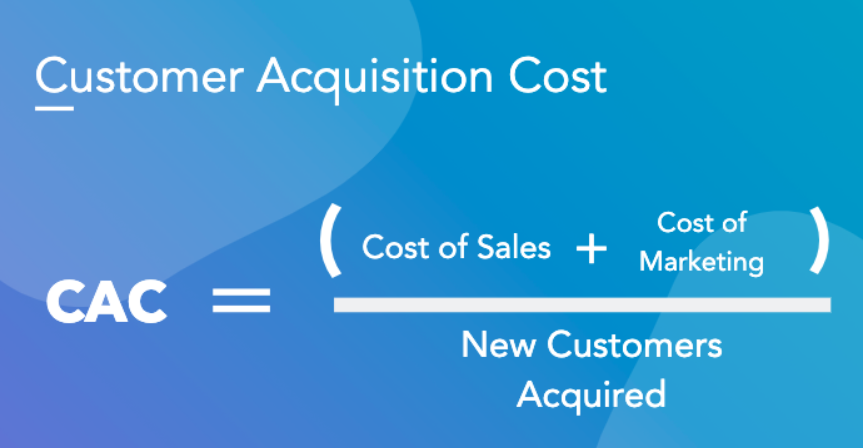
If you search for the phrase "CAC calculation formula" on Google, you will get the following basic formula:
CAC = (Total sales & marketing costs) / Number of new customers

In general, this formula seems correct, but this general formula still exists Missing quite a lot of detailed variables to be able to apply it accurately in practice. For example, applying the above formula to the data table below, we get a simple result in the CAC line.

But, what if in practice you realize:
➤ On average, it takes about 60 days for a lead to convert into a customer;
➤ Not all customers are new customers, some of them are old customers who continue to use the product (returning customers);
➤ This is a freemium product, which means that before users become paid customers, they are free customers, and the company still costs money to take care of these free customers.
Let's analyze how this information can affect the company's CAC. Let's answer the following questions one by one, each question is a filter class so we can refine the CAC calculation formula more accurately.
1. How long does it take on average to convert a lead into a paying customer?
The first problem with the basic formula above is that you don't take into account the time since you spent your marketing dollars (collect leads) until that lead turns into a paying customer. In the excel table above, this means, if this takes an average of more than 1 month, then The 453 new customers you acquired in January did not come from the $40,572 in sales & marketing expenses spent that month.
Below we have two examples of products where the process of converting from lead to customer takes a long time.
Example 1: Freemium products
Let's say you're using Dropbox. Obviously, as a first-time user of Dropbox, you will use the free package of this product, until at some point you run out of maximum storage capacity, then you will consider paying. For most users, this period lasts several months (for many, more than a year).

Example 2: SaaS products
Most SaaS companies take more than 60 days to convert from leads to paying customers, because the B2B sales process is much longer than B2C sales.

If you don't take this time period into account in your CAC calculation, it's easy to get it wrong (because in many cases, new customers in January do not come from January's marketing costs), thereby leading to incorrect business decisions.
In the example below, a month's CAC is calculated by dividing the total sales & marketing costs by the number of new customers for that same month, resulting in a higher CAC calculation.
Specifically, in March, the company sharply increased marketing costs by nearly 3 times compared to previous months, up to $32,432, to attract more customers with the goal of CAC not more than $125. The results of new customers of each month are as follows.

CAC (n) = [Marketing (n) + Sales (n)] / New Customers (n)
Calculated according to a simple formula, taking the total sales & marketing costs of a month divided by the number of new customers of the same month, we get the CAC of March as $148, higher than the expected $125 level. The company, looking at this number, will consider the March marketing campaign a failure, and decide to stop this campaign.
However, the company suddenly realized that it takes an average of 2 months to convert a lead into a customer, meaning that marketing money spent today will take 2 months to bring in customers. Applying new formula, Calculate CAC for month n by taking the total sales & marketing costs of month (n-2) dividing the total new customers of month n, we get CAC in May $111 (= $32,432/ 643).

CAC (n) = [Marketing (n-2) + Sales (n-2)] / New Customers (n)
Calculating this way, we realize that the company has just added a new customer (643 in May, compared to 502 in April), which still keeps the CAC from exceeding $125 → This number says that this marketing campaign is effective, and the company should continue.
Thus, the average time from lead to customer is an important parameter when calculating CAC, and can affect, more or less, the accuracy of CAC. There are some cases where you do not need to care about this parameter including:
➤ The lead-to-customer conversion time is short, often seen in many B2C products, where marketing costs can be used to acquire new customers within that month.
➤ Marketing costs are stable every month, so no matter which month your marketing costs are divided, you will get the same CAC.
To calculate CAC more accurately, we can consider adding another filter layer as follows:
➤ To generate a lead, you only need to spend marketing costs once;
➤ To convert leads into customers, you need to reduce sales costs throughout the sales process.
→ This means: If we assume the average time to move from lead to new customer is 2 months, then May's new customers are obtained from March's marketing costs, along with the sales costs of April and May. And assuming sales costs are spread evenly throughout the sales process, we have the formula:
CAC (n) = [Marketing (n-2) + 1/2 Sales (n-1) + ½ Sales (n)] / New Customers (n)
Applying this new formula, we obtain a new, more accurate CAC as follows:

So the first question about lead-to-customer conversion time has been resolved, now let's move on to the second big question.
2. What costs do you include in Sales & Marketing?
This is an important question so that the total Sales & Marketing costs are calculated properly. Let's go through some common mistakes.
Error 1: Not including salary in costs
You need to include the salaries of the entire Sales & Marketing team, not just the employees who spend 100% of their time on the sales & marketing process, but also those who dedicate part-time to it. (usually managers). CAC includes all sales & marketing personnel salaries, often called "Fully Loaded CAC".
Error 2: Not counting overhead costs
These are expenses such as stationery, equipment, office rent,... that you need to maintain the operations of the Sales & Marketing team.
Error 3: Not calculating software fees
Sales & Marketing software/tools (like CRM, chatbot, email marketing,...) also costs a fair amount of money, and has a large impact on CAC results.

However, for each different product, determining which costs to include in the CAC calculation formula is not simple. Let's go through some examples below.
Example 1: Spotify with Freemium model - Is there a cost to build a product/Engineer/Technical support?
Spotify is a product with a Freemium model. They have millions of users using the free version of Spotify, which in turn partly converts into paying customers.

In most companies, product building, engineering, and technical support are not part of the CAC formula (because they are primarily R&D). But in a model where free products are your primary way to acquire customers, shouldn't the costs required to support that free product also be included in your CAC? There are many mixed opinions on this issue, but I am inclined to answer "yes".
If you have engineers, product managers, or other roles in marketing & sales, you need to include their salaries and related expenses in the CAC calculation. Although engineers or product managers are not essentially part of the sales & marketing team, they are still necessary costs for you to acquire new customers in the Freemium model.
Example 2: HubSpot with SaaS model - Is there a customer care cost?
Most SaaS companies like HubSpot have a large customer service team, responsible for a variety of roles from onboarding new customers using the product, and providing care/support to keep customers using the product, or even convincing customers who have canceled the service to continue using the service.
From the above description, it can be seen that the customer service team plays a huge role in acquiring new customers, and therefore their salary and related costs (tools, overhead) also need to be included in the CAC calculation formula.
Example 3: Dollar Shave Club with E-commerce Subscription model - Is there a cost for Support, Shipping, and trial?
Dollar Shave Club is an e-commerce company with a subscription model, once famous for its $1 a month trial policy. Behind a one-month trial are many related costs such as marketing, shipping, customer support during the trial, etc. Should you include those costs when calculating CAC?

The answer depends on how you define new customers.
In the Dollar Shave Club model, you could argue that people on a $1 month trial are not yet paying customers, and when they renew their membership, they become a new customer. Therefore, the costs associated with implementing the trial month should be included when calculating CAC. Although these costs are offset somewhat by the $1 that customers pay, this is not much.
Every customer is the same, right? Not necessarily. When calculating CAC, we need to distinguish between new and returning customers (returning customers). In most companies, there are marketing budgets and efforts devoted to acquiring new customers, but there are also budgets and efforts devoted to bringing customers back.
A common mistake is to only count marketing costs to acquire new customers in the numerator, but count both new and returning customers in the denominator. This results in a lower CAC than it actually is, causing the company to misjudge its marketing effectiveness.
You can edit in 2 ways:
➤ Calculate sales & marketing costs for all customers, and count all customers.
➤ Clearly divide 2 types of customers (new and returning), along with sales $ marketing costs related to each type of customer.
SUMMARY
Through the above content, I want to note that there is no one-size-fits-all formula to calculate CAC, but depending on the business model, there will be different ways to calculate CAC.
To calculate CAC most accurately, in addition to simply applying the simple CAC calculation formula, you need to answer some important questions, including:
➤ How long does it take to convert leads into customers?
➤ What costs are included in sales & marketing?
➤ Clearly divide new customers and returning customers.