Hubspot is the father of the concept Pmarketing system (Marketing Funnel), a model familiar to most of us, allows businesses to segment the sales & marketing process, build customer attraction strategies through each stage, and measure effectiveness with conversion rate indicators. However, with the constantly changing movement of purchasing behavior, the traditional Marketing Funnel model is no longer suitable for growth needs and modern customer experience.
Flywheel - a new growth model has been born, promising to completely change the way businesses approach, sell and care for customers in the future.
To give you a clearer view of the Flywheel model, in this article ThinkZone will focus on exploring the following contents, including:
➤ What is Flywheel?
➤ Outstanding points of the Flywheel model with the traditional Marketing Funnel model
➤ How to apply the Flywheel model?
➤ Practical example of Amazon and MoMo e-wallet
---
Subscribe Newsletter And agree to receive notifications on ThinkZone's website so you don't miss out on useful articles every week!
---
WHAT IS A FLYWHEEL?
Flywheel can be loosely translated as "flywheel" - a mechanical device invented by James Watt (inventor of the steam engine in the 20th century) Invented to store rotational energy, helping the machine operate even when the energy source is interrupted. If you apply force to the flywheel, it will start to rotate. Then, with a properly designed engine, the flywheel will continue to spin even if you stop applying force, and spin faster if you give it more power.

From a business perspective, with a flywheel-like mechanism, Flywheel refers to a certain mechanism (engine) that businesses integrate into their products/business models to, after a few sales & marketing efforts, attract customers. (same as the initial force acting on the flywheel), businesses will automatically grow based on customers continuously using the product and introducing new customers (The flywheel continues to spin on its own and spins faster and faster if you continue to apply force, meaning the business pours in more sales & marketing resources).
If customers are satisfied, they will continue to use/buy the product and even recommend your product to more people. But if a business delivers a bad experience, this will hinder it from gaining new customers - just as friction hinders the rotation of a flywheel if the bearings are not smooth (bad customer experience), or if the motor is not properly designed (if the Flywheel mechanism is not built well enough).
In the following part of the article, ThinkZone will introduce to you some typical Flywheel models.
WHAT'S SUPERIOR ABOUT FLYWHEEL COMPARED TO THE FAMILIAR MARKETING FUNNEL MODEL?
Different from the traditional sales funnel model (including linear steps: Know - Understand - Believe - Love), Flywheel operates according to a cyclic mechanism.

With the Marketing Funnel model, you bring your target customers through each stage of the funnel, then according to a certain conversion rate, gain a number of customers at the end of the funnel.
However, with its linear nature, that process must be repeated continuously. If you stop pouring water at the top of the funnel, there will be no customers at the end of the funnel.
In Marketing Funnel, customer flow gradually loses energy as it passes through each part of the funnel, and reaches the bottom, Businesses only gain customers in a trickle. From the perspective of this model, customers are simply the result of sales & marketing activities, instead of one thing driving factor Contribute to the sales & marketing process of the product.

This is going against the trend of society when the rise of "word of mouth" marketing and customer loyalty will be factors that greatly impact the growth ability of businesses. It can be seen that businesses that rely solely on the funnel model will face increasingly high sales & marketing costs and increasing pressure to find new customers, in a market where competition is only increasing, not decreasing.
This funnel has revealed many limitations that affect the sustainable growth of businesses, and is no longer suitable for modern growth needs. The marketing funnel solves the problem of "creating" customers, but does not take advantage of that customer source as a driving force for stronger growth..
The Flywheel model, by placing customers at the center of the growth flywheel, fills the limitations of the Marketing Funnel model.
HOW TO DESIGN THE FLYWHEEL MODEL?
Whether you're using a traditional marketing funnel, an hourglass funnel, or a Flywheel model, all customers start out as strangers. However, unlike the Marketing Funnel that impacts customers through 4 steps "Know - Understand - Believe - Love", the Flywheel is shortened to 3 steps::
Attract - Engage - Delight
This process is designed as a cycle, with the customer at the center.

Through each stage Attract - Engage - Delight), strangers will gradually convert to Prospects (Potential Customers), Customers, and finally Promoters.
The difference between the Flywheel model and the Marketing Funnel is its circularity. With the Flywheel mechanism properly integrated into the product, customers using the product will become Promoters, continuing to bring in new Prospects, then those Prospects will be converted into customers, and the cycle continues. Thus, with a well-designed Flywheel, the customer growth process can take place automatically and stably, without the business having to spend too much sales & marketing resources.
Let's go deeper into each stage.
Attract – Attract
The goal of the Attract - Attract phase in this Flywheel model is that businesses only focus on attracting potential customers who truly have needs (target customers) and have the highest possibility of becoming customers in the future. Therefore, identifying the right customer base is very important. You need to focus, not spread out. Because only Prospects that truly match the target customer profile can "love" your product, become Customers, then become Promoters that pull in other Prospects, and the flywheel will have enough initial force to start the first rotation.
A successful Attract phase will be accompanied by a conversion rate from Prospect to Customer large enough to meet the business's expectations.

Engage – Interaction
During the Engage - Interaction phase, businesses need to focus their strategies on helping Prospects achieve their goals in the easiest and fastest way, making them quickly realize that the product solves their needs. (the Magic moments), and "love" that product. This is when Prospects with very high rates will turn into Customers.
Businesses can strengthen customer relationships by interacting regularly, personalizing their experience through many interaction channels such as website, mobile app, email.... thereby keeping customers staying as long as possible with the product. One of the effective tools to measure user retention rate with a product is Cohort Analysis, readers can learn more in the article: How to build and read Cohort Analysis.
To evaluate the effectiveness of this stage, we look at the conversion rate from Customer to Promoter.
Delight – Pleases
At this stage, the business's strategy should focus on supporting and helping customers achieve their goals with the best product experience, making them love the product, and be willing to recommend the product to friends and acquaintances, attracting more customers to the company. And don't forget to build features that help users share products with friends, from as simple as a "share" button, or more elaborate programs to introduce products to users.
Readers can also refer to the article about How to design Viral loop to be able to build the features/user introduction programs that best suit your product.
The success of the Delight stage is measured by the average number of new Prospects that a Promoter brings to the business.

HOW IS THE FLYWHEEL APPLYED IN PRACTICE IN BUSINESS?
Let's see how large businesses design their Flywheel growth model through practical examples from Amazon and MoMo e-wallet.
Amazon
Amazon is an American e-commerce empire with a capitalization of nearly 2 trillion dollars, 7 times higher than Vietnam's GDP in 2020 after 25 years of establishment and development under the leadership of Amazon.com. Jeff Bezos. And The secret to Amazon's success is applying the "Flywheel effect" to its development strategy .

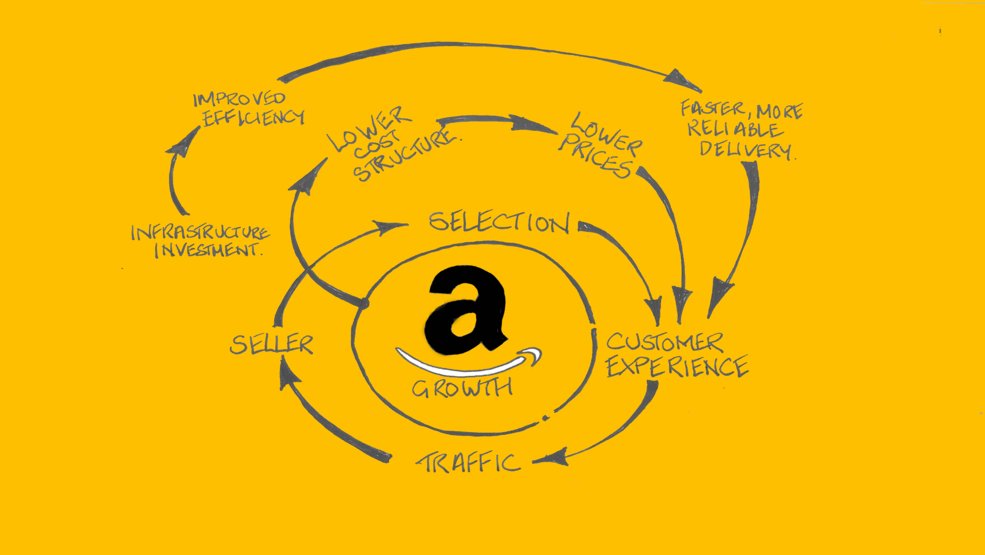
Amazon's Flywheel was sketched on a napkin by Jeff Bezos.
In the beginning, Bezos' strategy was simple: encourage more people to shop with discount codes, thereby attracting more sellers to effectively use Amazon's infrastructure. (the discount code is the initial impact force to push the flywheel).
Thanks to starting with a focus on building a distinct Customer Experience (from Customer First philosophy) With a really good product and service, Amazon builds a huge user base. The huge user base leads to more merchants participating; thereby creating a lot of product options. On the other hand, this growth allows Amazon to optimize warehousing, shipping and costs per item thanks to large supply; The result is a reduction in selling prices, making customers extremely satisfied.
Besides, with the aim of bringing more customers into the company's ecosystem and accelerating the flywheel, Amazon deeply discounted many of its devices on Prime Day - an annual Amazon shopping festival, countless products will be discounted and that offer is only for customers who purchase Amazon's Prime package. (apply more force to accelerate the flywheel). This strategy was successful with 900 million USD in Prime Day sales in the first year, and by Amazon Prime Day 2020, this number recorded a record of more than 3.5 billion USD, with a huge number of customers.

Total amount of money users saved when shopping on Amazon Prime Day 2020.
Many customers create more attraction for Amazon to have more sellers. Many sellers offer a variety of products at reduced prices, attracting many customers. And the flywheel keeps spinning, spinning faster and faster (large scale of sellers and buyers), is steadily energized (shopping programs, promotions), and rotates stably with a good bearing (products and services that provide good customer experiences).
MoMo Wallet
In Vietnam, MoMo is also a typical example of applying the Flywheel model to user growth.
It is also a wallet with a quick and convenient money transfer function, without the need for cash transactions like many other e-wallets, but MoMo has created its own difference through the philosophy: Fun & Socialable Experience.
That philosophy is realized by making money transfers more than just easier (transfer money, divide money, request money,...) but even more fun. That is also what makes anyone able to become a philanthropist with MoMo Piggy Bank, seeing that they are a good person even though they are not rich; Taking care of virtual pigs is sometimes fun. Or Walking With MoMo helps improve health, especially for office workers; while being able to connect together,…

All of these factors make users see the meaning of every day in MoMo, and they continue to explore other useful services MoMo brings. Buying movie tickets has never been easier; Pay electricity and water bills at the touch of a button; Go to CircleK or a drink shop across the street to buy food and drinks without having to bring money; Even buy Vietlott lottery tickets in just a split second.
That's when MoMo doesn't need to spend money to still get customers, and they also introduce many new customers because they see MoMo as not just a boring cash replacement tool but a place to connect the community and integrate super conveniences for them and their friends. And of course, MoMo has also implemented programs to introduce friends to MoMo, further facilitating the process of Promoters inviting more Prospects, and the flywheel continues to spin.
SUMMARY
Thus, if in the marketing funnel model with a linear nature, all resources are used to attract users to the top of the funnel, the business stops having customers when it stops "pouring water" into the funnel; With the Flywheel model, initial resources are used to create an initial customer base, then through the Flywheel mechanism, businesses continuously have more customers without having to pour too many resources into sales & marketing.
Summary and reference:
https://www.hubspot.com/flywheel
https://amis.misa.vn/9641/banh-da-flywheel-la-gi-cach-ap-dung-banh-da-vao-tinh-doanh/
https://advertisingvietnam.com/mo-hinh-flywheel-cho-marketing-kich-hoat-va-tao-da-phat-trien-p18268
https://insights.magestore.com/posts/lanh-the-pheu-marketing-bang-trai-nghiem-khach-hang
https://marketingtrips.com/marketing/marketing-funnels-da-het-thoi-va-thay-vao-do-la-fly-wheel/