*The article was shared by Mr. Doan Hai Nam - Accelerator Program Manager of ThinkZone Ventures
We always talk about Unicorn, about the vision of creating startups worth billions, even tens of billions of dollars, but not many Vietnamese founders really imagine what Unicorn is like, and what the journey to get there really is like.

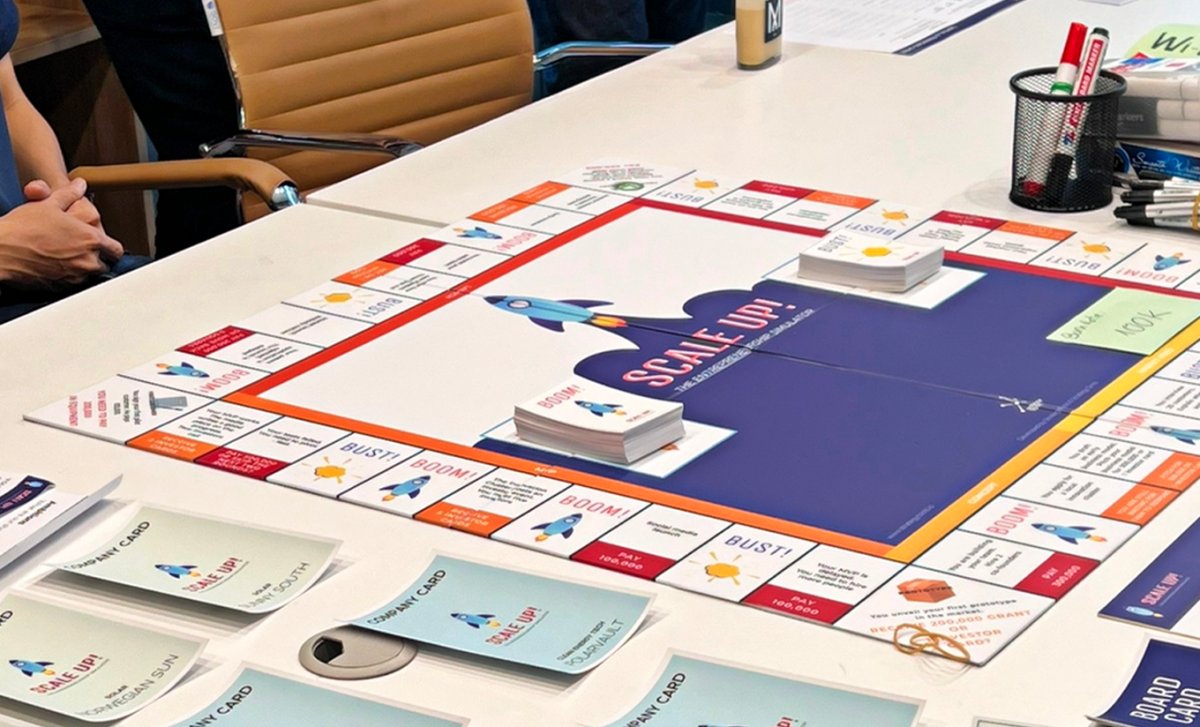
Image of the game Scale Up! Simulation
Did you know, average in the world, a startup that reaches the 1 billion USD valuation threshold usually calls for a total of 200 - 400 million USD in capital, which is a lot of money (and many rounds of capital).
This means, if you want to build a Unicorn startup, you need to imagine that one day you will call hundreds of millions of dollars in investment, own a product with tens of millions of users (if B2C) or hundreds of thousands of customers (if B2B). That is truly a big ambition, especially for a small market and a developing startup ecosystem like Vietnam.
To reach the Unicorn threshold, from the perspective of raising capital, founders need to (1) have an ambitious vision, (2) dare to raise tens of millions, even hundreds of millions of dollars to realize that vision, and (3) structure the capital raising rounds appropriately.
That's why ThinkZone brings Scale Up! Simulation about Vietnam to help founders experience the journey of building Unicorn.
The above 3 factors will be shared by ThinkZone in this Recap article from experience with Scale Up! Simulation.
About Scale Up! Simulation
Scale Up! Simulation is an activity that simulates the growth and capital raising process of a startup from establishment to divestment (through IPO or M&A).

With a format similar to the Monopoly Board game, the content of Scale Up! designed to truly reflect the startup's development and capital raising process. The mechanism of Scale Up! are briefly described as follows:
➤ Each session of playing Scale Up! Consists of 3-5 teams (representing 3-5 startups), each team consists of 2-3 people (representing the company's co-founder). Each team starts with $500,000 in working capital.
➤ Teams take turns rolling the dice to move to any square on the game board, representing the new progress the startup has achieved. Each roll of the dice, the startup must pay a certain amount of money (burn rate, representing the cost of operating the company), this amount of money increases after each round of capital raising (representing a larger burn rate as the company grows).
➤ With each (random) jump, the startup's new progress can be positive (receive investment offers, have revenue,...) or negative (lose money, slow progress,...).
➤ The winning criteria depends on the Coordinator, it could be "the first team to successfully call a $50 million capital round", or "the first team to reach the Unicorn threshold",...
Every session of playing Scale Up! It can last 4 hours, 2 days, 1 week or 1 month, depending on the difficulty and requirements set by the Coordinator.
The value of Scale Up! For startups lies in the practicality of this simulation activity with the capital raising process.

Business, investment, strategy cards create a realistic experience for players
Participating in Scale Up!, founders will have to:
➤ Calculate the capital raising plan under monthly burn rate pressure to keep the company operating.
➤ Build a long-term capital raising roadmap to reach the Unicorn threshold, determine (1) expected growth milestones, (2) amount of capital needed to call, and (3) expected valuation for each round.
➤ Choosing the right investor depends on the appropriate level of development strategy and financial capacity of the investor.
➤ Design the Board of Directors, Captable, consider investment terms for each round, etc.
➤ Choose a divestment strategy, calculate divestment value, ROI for shareholders,...
And many other practical problems, helping founders experience the capital raising journey from startup establishment to Unicorn, and divestment.
1. Ambitious vision is a prerequisite

Unicorn was born to solve big problems, bringing great value.
You are doing a B2C startup, have ~1,000 users in the Pre-seed stage and have achieved Product-Market Fit → Congratulations! You are ready for the scaling phase.
You reach the Seed - Series A stage, starting to grow to 10,000 - 100,000 - 1 million users → Congratulations! You have demonstrated the product's ability to scale, and may have become a prominent name in the Vietnamese market. In fact, many Vietnamese startups have reached the threshold of millions of users without needing to raise large capital.
However, think about the day you reach 50 million users, one day you become a Unicorn. Not growing from 1 million to 2 or 3 million users, but growing to 50 million, 500 million, or 1 billion users (Facebook has 2.9 billion MAUs), what will happen to the company then? What will you need to do?
Don't just dream in general that you want to build Unicorn, quantify the definition of Unicorn for your own startup.
For example, with my hypothetical company (B2C) in Simulation, according to market benchmarks, I found that the multiple between the company's valuation and the amount of GMV in the industry is ~4x. This means, to reach the $1 billion valuation threshold, my startup needs at least $250 million GMV.
This goal helps me break it down into other goals, such as number of users, transactions, market,... that need to be achieved.
And so, I have a clearer picture of what my Unicorn looks like and the business strategies I need to implement. In particular, quantifying goals also helps me motivate the team, and convince investors to contribute capital.
2. Dare to call for large capital

Most startups are afraid to raise large capital because (1) the startup has already broken even, there is no cash flow pressure, and (2) the founding team is not clear on what to do if they have a lot of capital.
However, once you have clearly defined the big vision, along with specific goals on valuation, number of users, GMV, revenue,... and from the company's Financial Model, you will be able to forecast future capital needs.
For example, to reach 250 million USD GMV, how much do you need to spend on marketing, how many employees, open branches in how many countries, how many factories to build, etc. From there, you can determine the need for capital to call, and answer the important question: "What is the purpose of raising capital?" → to grow towards big goals faster.
That's why many startups around the world, whether in the Seed or even Pre-seed round, have raised tens of millions of dollars in capital.
Raising large capital is not a problem. The issue is whether you can convince investors that you will achieve your growth goals. And this depends on 3 factors: (1) Reasonable growth roadmap in the Financial Model, (2) Proving the startup's ability to achieve those goals, and (3) Expected profits for investors when divesting.
3. Structure capital raising rounds appropriately

There are some (average) benchmarks in the fundraising process that startups should keep in mind when designing funding rounds (of course in the ideal case that the startup achieves its stated business goals):
(1) The next round's valuation is usually 3x - 5x compared to the previous round's valuation;
(2) Shares are diluted at each round within the range of 15 - 20%.
If you don't pay attention to these points, it's easy for a startup to fall into a situation where the co-founder has too few shares right from too early capital calls, causing investors to hesitate to participate because of the risk of the founder losing control and motivation to start the startup. There are VCs who only invest if the total shares of the co-founders are more than 50%. Among the reasons why VCs refuse to invest, this is probably the most unfortunate reason.
Another reason that may make investors hesitant to invest money is the company's growth rate. Besides the startup's capital needs, founders also need to understand the ROI (Return On Investment) needs of investors. VCs can invest in many different startups, so even if the founding team is good and the startup is growing, but if that startup only grows slowly, VCs can absolutely invest in other startups with higher growth rates (ie valuation between larger growth rounds).
In Scale Up! Simulation, the founders must solve the simulation problem of a VC's ROI when investing $2 million at a $10 million pre-money valuation, that with different growth scenarios (bankruptcy, flat growth, slow growth, strong growth), what is the VC's expected profit, and what threshold does the startup's growth projection need to be to expect a profit of at least 3x after 4 years. This exercise helps founders understand more about the investor's perspective.
Or another interesting, and very practical, problem that we encountered in Simulation, is Linda. At that time, my startup was still small, had not yet raised capital, and the runway was only 3 months old. I met a veteran advisor in the industry named Linda, and Linda was able to help the company get 6 investment proposals from investors. In return, Linda would have 8% of the company's shares, and 2% + 2% + 2% more shares after each of the next 3 capital raising rounds. This is not a small amount of shares, and we have to decide whether to accept Linda's proposal or not, as well as calculate the impact of this proposal on the company's next capital raising rounds.

Mr. Nir Melamud - Strategy Tools Partner (right) directly coordinates the startups' participation in GMA
What do you get and what do you create from a Unicorn startup?
All of the above problems are problems that have appeared in reality, and founders will experience them through Scale Up! Simulation.
To summarize this Simulation, we created 4 Unicorns. When I divested my startup, it was valued at $7.56 billion, with a total raised capital of $246 million through 8 rounds. Regarding the Linda problem, my team accepted this advisor's proposal, and by the time of divestment, Linda held 6.45% of the shares, owning $487.3 million in assets (just by connecting 6 VCs to make investment proposals for the company, with 0 VND of investment from Linda personally).

Scale Up - Mini Cap Table Excel
The best team built Unicorn at a valuation of $3.23 billion, and sold it to Microsoft at a valuation of $13.1 billion.

On the journey to reaching $13.1 billion, the startup raised a total of $536 million through 5 funding rounds, meaning it created an additional $12.6 billion in value for the economy. Co-founders (with a good structure of capital raising rounds), still hold 45.6% of the shares, equivalent to $5.98 billion in assets. Investors also reaped big profits, with multiples up to 3,152x for the first angel investor.
Thereby, we can truly see how great the (financial) value Unicorns bring to the economy, founders and investors.
Summary
Scale Up! Simulation is not just a game, but a MasterClass for startup growth and capital raising. This simulation helps founders have a broader, clearer view of the journey of building a Unicorn startup, and experience very real challenges on that journey.
ThinkZone will continue to apply Scale Up! Simulation on training activities in Global Minds Accelerator (GMA), appointment of founders in upcoming batches of the program.
