

In this article, let's ThinkZone Looking back at the failure lessons of the two giants Myspace and Friendster, along with the factors that made Facebook the dominant global social network it is today.
---
Subscribe Newsletter And agree to receive notifications on ThinkZone's website so you don't miss out on useful articles every week!
---
OVERVIEW OF FRIENDSTER AND MYSPACE
First, let's go through some general descriptions of Friendster and MySpace, along with the impressive numbers that these two social networks have achieved.
About Friendster
Friendster is the world's first social network, founded by Jonathan Abrams in 2002. Having just gone through the crises after the Dot com bubble, and people were still discovering the potential that the internet brought, Abrams came up with the idea that each person could own their own online profile page, but instead of just being limited to posting photos and describing themselves, they could connect with many other people's profiles, build networks, and interact with each other like in the real world. real world.
With a friend supporting this idea, Abrams started working and completed the prototype after 3 months, with a mechanism that helps users connect with other users who share certain characteristics in terms of interests and personality. Very quickly after that, Abrams raised several tens of thousands of dollars from angel investors, and $400,000 from a number of other investors.
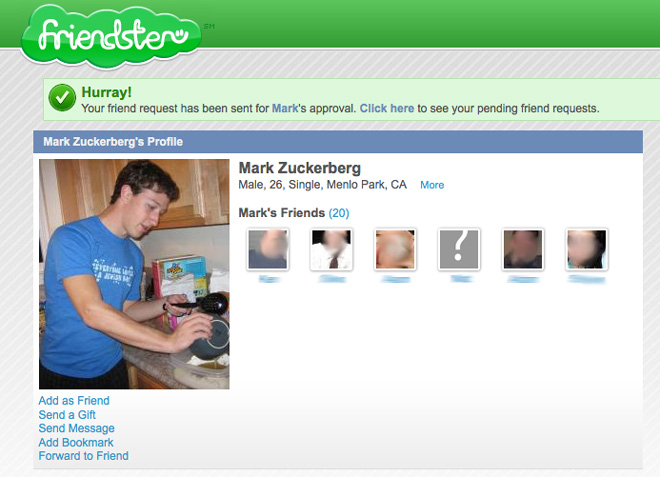
Mark Zuckerberg's profile page on Friendster.
Friendster was officially launched in March 2003, and reached 850,000 users in just 3 months. Another 4 months later, Friendster reached 2 million users, with 10 million pageviews every day. Until then, at its peak, Friendster had 115 million users.
At the end of 2003, this social network rejected Google's acquisition proposal for $30 million, and received an additional $13 million from Kleiner Perkins and Benchmark Capital, at a valuation 53 million USD.
About MySpace
MySpace was founded in 2003 by Tom Anderson, Chris DeWolfe and Jon Hart, inspired by the Friendster model but omitted some features that the founding team considered inappropriate. MySpace helps users create personal profiles with many media formats such as photos, videos, music or even blogs, with features that allow users to connect with each other to create their own community.

MySpace user profile page.
By 2004, MySpace had more than 1 million users and was gradually becoming the dominant social network in the US market. From 2005 to 2008, MySpace grew from 20 million to more than 75 million users per month. Even in 2006, MySpace surpassed Google and became the website with the most visits on the Internet.
In 2005, MySpace was acquired by News Corp for 580 million USD, becoming part of the ecosystem of this giant in the entertainment industry.
---
FROM PEAK TO FAILURE, AND PRECIOUS LESSONS
What happened to make Friendster and MySpace from giants with tens of millions of users gradually losing market share to Facebook, to today only being mentioned in case studies of classic failure lessons?
1. Friendster's failure story
At its peak, Friendster founder Jonathan Abrams rejected Google's $30 million acquisition proposal, and received a $13 million investment from Kleiner Perkins and Benchmark Capital, a deal that Abrams later admitted to his fatal mistake during the negotiation process.

Jonathan Abrams, founder of Friendster.
“Too many cooks in the kitchen” (shared from a board member of Friendster)
Since this deal, Abrams only has about 1/3 of Friendster's shares and no longer holds veto power on a board of directors consisting of 5 people. Specifically, the term sheet stipulates that a 5-member council will be selected to unify the company's decisions, of which 2 members are selected by the VC side, 2 members are selected by the startup, and 1 member is agreed upon by both parties.
Abrams took a seat, and chose Tim Koogle, angel investor of Friendster and also CEO of Yahoo from 1995 to 2001. The VC side chose John Doerr, an executive at Amazon and Google, and Bob Kagle, a representative from Benchmark Capital. The remaining member chosen by both sides by consensus is Roger Lee, a Partner of Battery Ventures. Among the five people, Tim Koogle was nominated as interim CEO (interim CEO), is in charge of Friendster's operations, while Abrams focuses on building the management system.
With his large network, Abrams in turn attracted many talented personnel: founder of Collabra Software (later sold to Netscape for $108 million) In charge of engineering, product manager from Yahoo, member of eBay's founding team.

However, having too much talent on the team is also a double-edged sword, especially when Abrams no longer holds autonomy over the company. Each member has his or her own ideas about development direction. “It seems like there is always a war between the company's leaders, everyone has their own plan.”, shared by Chris Lunt, Technical Director of Friendster in 2004.
As a result, Friendster fell into chaos, with many directions being implemented at the same time, instead of focusing on improving the product. Many projects were launched together including: blog (with Six Apart), video sharing platform (Grouper), personalized search engine (Eurekster), VoIP (with GloPhone), and Internet Radio (with Pandora).
Problems cannot be solved by technology and team
Later, the number of members on the board of directors increased to 6 people, and Abrams gradually became isolated, losing his voice on the board. While the Friendster platform itself is facing many technological infrastructure problems as the number of users increases too quickly, Abrams is still obsessed with signing more cooperation programs, instead of focusing on solving technological problems for the platform.
By 2005, Abrams gradually withdrew from board meetings. With other members in charge, the company focused on rebuilding the entire technology infrastructure, although there were still major problems with long page load times. Furthermore, the decision to rewrite Friendster's entire code also caused internal division, with many members believing that this was unnecessary, and that the team should instead spend time building more features to compete with MySpace and Facebook.
The performance of the technical team is decreasing, projects are going nowhere. Board members also lack experience in operating a technical team to be able to resolve internal issues that directly affect product quality.

Losing market in the US
In early 2004, a Friendster member realized that the website's traffic often peaked at 2 am. After researching, it turns out that more than half of the website's traffic comes from Southeast Asia, mainly from the Philippines.
From a business perspective, this is not a happy result, because Friendster is making millions of dollars every year from advertisers targeting American users, while more than half of their users come from elsewhere. The company faced a difficult choice: spin off into a product branch specifically targeting the Southeast Asian market, or position Friendster to become the largest social network... Philippines.
But because users from the Philippines come mainly due to invitations from American users, any direction carries the risk of negatively affecting the existing user base in the US. Furthermore, Friendster gradually became a platform where users went there just to browse interesting profiles, view photos and videos, instead of connecting with each other as the vision that founder Jonathan Abrams expected.
At the end of 2004, MySpace surpassed Friendster in terms of Monthly active users in the US with 22 million MAUs, while Friendster's figure was only 1 million users. Later, Facebook also surpassed both of these social networks in terms of number of users since April 2008.
Losing motivation in the team
Faced with so many problems, Friendster's board of directors also lost motivation, especially founder Jonathan Abrams. In 2 years, Friendster changed up to 4 CEOs, investors did not follow up in the following investment rounds, Abrams was no longer interested in Friendster, gradually disappeared from the media, quietly building a new startup, with the expectation of doing what he could not do at Friendster.

Internal team problems clearly affect business results, this social network is in turn overtaken by other competitors, with better products and user experience, in the number of users. Although Friendster remained for a few more years and focused on the Asian market, the world's first social network could be considered dead in 2006.
In 2011, Friendster transformed into a website specializing in games, then stopped operating in 2015, marking the end of the game. “one of the biggest disappointments of the internet era”.
* Lessons learned
It can be said that Friendster's failure comes from a number of main reasons:
➤ Founder gives up too much control of the company to receive investment capital, leading to failure in maintaining the vision and development direction for the company.
➤ Conflicts about development direction in the leadership team, choosing people who do not share the same vision.
➤ Scattered resources, lack of focus on improving products and user experience.
2. MySpace's failure story
The period 2004 - 2007 marked the peak period of MySpace, especially 2005 with the merger with News Corp. At that time, MySpace owned more than 20 million users, with a valuation of about 1.5 billion USD. In 2007, MySpace reached more than 300 million users, valued at up to 12 billion USD.
However, this deal was also a turning point in the decline of MySpace.

Once again, conflicts about development direction killed the startup
If Friendster founder Jonathan Abrams failed to convince the board of directors to follow his direction, the M&A deal with News Corp left the co-founder team completely without the right to decide on MySpace.
With the media potential of a giant in the entertainment industry, News Corp has helped MySpace reach more than 300 million users, surpassing Google to become the most visited website in the US. However, this corporation considers MySpace to be a communication tool rather than a technology social networking platform.
Specifically, News Corp wants to take advantage of MySpace as a channel to attract users, with the ultimate goal of drawing them to other product/service channels in News Corp's ecosystem. (jobs, entertainment services, tourism,...), rather than retaining users on the MySpace platform. They prioritize optimizing advertising revenue over improving user experience.
This leads to many consequences.
Products do not develop around user needs
Since merging with News Corp, MySpace has been guided by experts with impressive MBA degrees and the mindset of a media person. As part of News Corp's "vast ocean", MySpace is evaluated by metrics of revenue, costs, ROI, and clear development plans. In other words, the MySpace startup was run like a traditional company.
In contrast, Facebook, founded by a group of students, lacked business sense, had no clear working process, no profit estimates, and no fixed roadmap for product development. All they know, and focus on doing, is to continuously improve the product to meet user needs, to increase the number of users as much as possible.
And it is Facebook's "startup vibe" that is the decisive factor that helps this social network gradually rise to the top of the market.

Previously, MySpace impressed users with the feature that allowed users to connect with each other and personalize their profiles in a variety of ways, but gradually, while Facebook continuously improves the product with many new features such as fanpages, groups, group chats,... MySpace still seems to have not changed.
Focusing on advertising revenue causes MySpace to make a big trade-off, specifically the user experience part is no longer of interest. MySpace gradually became a website aggregating media information, filled with advertising, and users gradually switched to Facebook, where users had more variety in expressing themselves and connecting with friends, in accordance with their expectations of a social network.

And obviously, a social network company that focuses on making social networks will create a better product than a company that makes social networks mainly for communication purposes. Since April 2008, Facebook's user base began to surpass MySpace's. In the 3 years since 2008, MySpace lost more than 40 million MAUs, laid off most of its employees, and lost all of its co-founders.
Despite many repositioning efforts, MySpace never regained its previous success. In 2011, News Corp sold MySpace to Times Inc for only $35 million. Today MySpace is still active, but is only a small-scale social network for the music industry.

MySpace today.
* Lessons learned
Some of the main reasons for MySpace's failure include:
➤ Merging the company into another corporation with an orientation inconsistent with the startup's orientation.
➤ Failure in the product development process to meet user needs. Sean Parker, Former President of Facebook shared: “They were once a giant, with extremely large network effects and scale. But hThey didn't develop the product well enough, fast enough, and kept the same bad design for all those years. There was a time when if they simply copied Facebook exactly fast enough, they could have become Facebook."
SUMMARY
The failures of two giants Friendster and MySpace leave valuable lessons for startups. When scaling startups, they need to be very considerate when raising capital from VC or merging into large companies. They should look for people who share the same development direction, and avoid the situation where the founder loses the right to decide on the company's direction.
In 2006, Mark Zuckerberg also flatly refused an acquisition proposal from the giant Yahoo for up to 1 billion USD, when Facebook only had 20 million users, and we all know who is the giant today.
In addition, Facebook's success also shows the importance of a user-centric mindset, in which continuously improving products quickly and well to meet user needs is a key factor that helps small startups dominate the market, while big companies still struggle with cumbersome processes, or are distracted by many inconsistent directions.
Reference
https://screenrant.com/why-when-myspace-failed/
https://www.huffpost.com/entry/how-myspace-fell-apart_n_887853
https://bizzbucket.co/myspace-failure-analysis/
https://www.forbes.com/sites/adamhartung/2011/01/14/why-facebook-beat-myspace/?sh=3a75b176147e
https://www.forbes.com/sites/gilpress/2018/04/08/why-facebook-triumphed-over-all-other-social-networks/?sh=3e1099476e91
https://www.inc.com/magazine/20070601/features-how-to-kill-a-great-idea.html