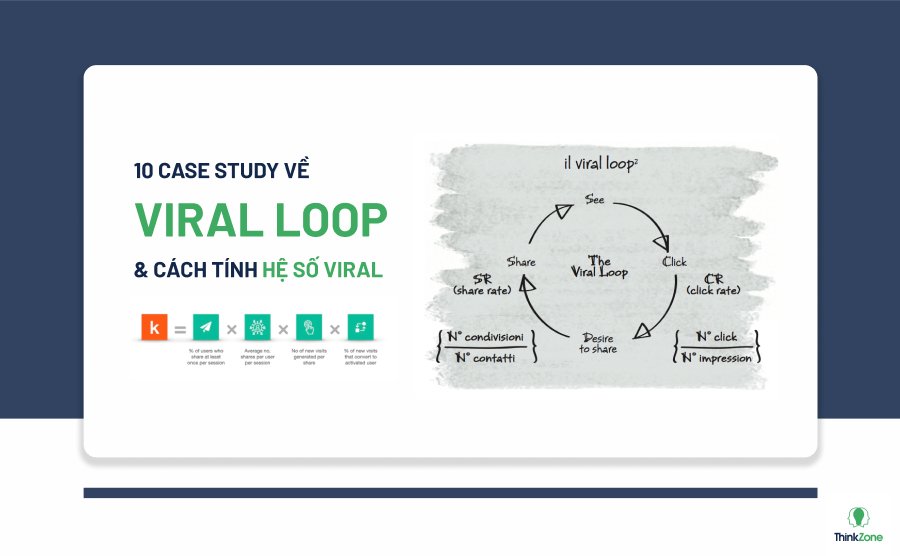

We often think of viral through a company deploying a massive communication strategy, be it a touching, inspirational TVC, or a creative strategy. (like Xiaomi batch Change logo design, or Gucci replaces one avatar with squiggly logo).
---
Subscribe Newsletter And agree to receive notifications on ThinkZone's website so you don't miss out on useful articles every week!
---
This article talks about achieving Viral growth through a different mechanism, on the aspect of product design instead of marketing, specifically design. Viral Loop. The content in the article, along with 10 case studies of major startups, includes:
➤ Marketing originally came from the product
➤ Note before designing Viral Loop
➤ How to design Viral Loop?
➤ What is Viral coefficient?
MARKETING ORIGINALLY COMES FROM THE PRODUCT
This is a very good quote that impressed me when I read it Mr. Le Ngoc Long's blog, Co-founder & Former Marketing Manager of TopCV, and currently Head of Growth of Finhay.
We often see marketing through spreading information about products through different campaigns and communication channels, through which the company brings the product closer to the user, and hopes that the user will find the product useful and then introduce it to other users.
So, why don't we integrate marketing elements into the product itself? More specifically, making product introduction an essential part of the user's product usage process?

In this direction, if cleverly designed, users introducing other users to use the product will become more natural, reducing friction. (rough translation: barrier) when introducing users, and without any pressure from the company. At the same time, the cost to build user introduction features is generally much smaller than massive media campaigns, thereby increasing ROI.
From later in the article, we will call this user referral mechanism Viral Loop (because each user will introduce other users, and the loop continues). This is also a popular Growhack strategy.
And because Viral Loop can increase the number of users very strongly, it is especially necessary for products that need a large number of users to create value for users such as games, social networks, e-wallets, telecommunications networks, and combined working tools. (collaborative working tools),...

NOTES BEFORE DESIGNING VIRAL LOOP
The first and resolute condition before designing Viral Loop is that your product must bring value to users. If you have a product that no one wants to use, then (1) is that no one will want to recommend the product to others, and (2) is a new user and will not use the product long term.
Viral Loop is a strategy that serves the Growth process, and Growth is always ranked last Product - Market Fit. Therefore, don't burn the stage because of the appeal of the word "viral". Focus your resources on going from 0 to 1 first (Product - Market Fit), and then think about the journey from 1 to 10 (Growth).
If you are confident that your product has achieved Product - Market Fit, let's move on to the Viral Loop design process.
HOW TO DESIGN VIRAL LOOP?
Viral Loop design revolves around the problem of choosing which time in the User Flow to integrate the user referral mechanism, designing a large enough motivation and the best referral/receiving experience.
Where to integrate the user referral mechanism?
Some products are easier to build a Viral Loop than others, because the nature of those products requires users to introduce other users to use the product.
For example, the classic case study of Hotmail, a free and automated email sending tool, with text “P/s. I love you. Get your free email at Hotmail” at the end of every user's sent email body.

With this simple strategy, Hotmail grew rapidly, reaching 12 million users in just 18 months and was then acquired by Microsoft for 400 million USD. (which is the predecessor of Outlook). Today we can easily see similar strategies applied by automatic email sending products such as Mailchimp, GetResponse,...
Another example is document storage tools such as Google Drive, OneDrive, Dropbox. For working documents, a big need that always goes hand in hand with the need for storage is the need to share, because with almost every working document you upload to Drive, there will soon be a time when you share them with colleagues, partners, and user introduction is a natural, inevitable part, without much marketing effort.
An ideal Viral Loop is a Viral Loop in which user referrals take place completely voluntarily, because it is an essential part, creating value for both ends. (referrer and referred person), and that users will receive additional value when referring other users. Products of this nature include coworking platforms, social networks, communication tools (email, texting),...
Motivation for user referral mechanism
Not every product is easy to create Viral Loop. These are products where inviting someone else doesn't add any value to you when using that product, or the value isn't too clear. For example, e-commerce channels, blogs,...
With such products, the company will have to find a way to create value for users who are active in recommending the product.
A classic example is Dropbox Get up to 16GB of additional storage if you invite additional users. At that time, 16GB of storage was something really precious to users, and caused Dropbox's user base to increase dramatically, while the costs incurred for Dropbox were extremely small.

A few years before that, PayPal Also applied a policy of giving $20 to each user who introduces a new user. This is almost an "all or nothing" move because it costs the company 60 - 70 million USD for "buying users", a huge number for an early-stage startup. But the results exceeded expectations with galloping growth of 7 to 10% per day, PayPal reached 100 million users in a very short time.
Some other examples of similar policies that readers can learn more about include:
➤ Trello Give credits for using the Premium version to users who refer other users.
➤ MoMo Give away 100,000 VND to your wallet for each user who successfully invites friends to use MoMo.
➤ AhaMove donate 150,000 VND for similar activities.

However, using money to buy users is not always feasible, especially for companies that do not have much capital, or products that do not have revenue like blogs. If these are products where the user referral mechanism is not too obvious as mentioned above, you will need to carefully explore the user journey using the product to find touchpoints/customer needs where you can integrate the referral mechanism into it.
An example of this is event ticketing platforms like Eventbrite, TicketBox,... These companies recognize the organizers' need to promote events and share interesting events with users' friends, so they have added a "share event" button so people can easily send event links to each other.
With TopCV, an interesting insight that the TopCV team found when researching customers is: there are many users who, after creating a CV on TopCV, will want to download that CV, then send it to friends and acquaintances to ask for feedback to improve the CV. Besides, the team also realized that those users were quite "lazy" to rename files, so they added a CV download button with the default file name ending in "TopCV" to spread the company brand more widely.
Design the referral mechanism to be easily recognizable and bring the best experience to users
Obviously, a Viral Loop will not bring any value if users do not know of its existence.
Your task is to integrate information and call-to-action buttons about user onboarding into User Flow so that almost every user using the product knows about this mechanism. A small marketing campaign to launch a referral program is also an option applied by many companies.
You will not want to place information about your referral program in locations or pages that users rarely pay attention to, and also do not want to spam so much that users feel annoyed and have an aversion to the product.
So choose concise information that clearly shows the value the user receives, with a clear call-to-action, and place it in an easy-to-observe location.

Pay attention to the onboard experience of new users
How to ensure that after receiving the invitation, the new user has a good experience is also very important. This shows that the invitation brings value to the recipient, the recipient also understands that value, and the onboard user experience is as short, simple, and convenient as possible.
Regarding onboarding new users, one element that you should pay special attention to is design the Magic moments (also known as the Aha moment, the Wow moment). Simply put, this is the moment when customers realize that your product truly brings value to meet their needs, the first time they use the product.

Readers learn more about the Magic moment in the article: What is “The Magic moment”?
Your problem at this stage is to design User Flow so that new users can receive the core value of the product as quickly as possible, taking them from registered users to active users quickly.
Some examples for optimizing the new user experience include:
➤ From the stage of receiving an invitation to use the product: Each invitation email to use Airbnb products will include the inviter's photo and name, along with a friendly text "Your friend Morgan gave you $25 off your first trip on Airbnb, the best way to travel. Be sure to say thanks!", and a clear call-to-action button "Claim Your Credit" → This is a very friendly, personalized, non-marketing invitation, and makes the recipient more inclined to respond and explore the product.
➤ Go to product onboard stage: Facebook or LinkedIn, with their social network model, always clearly highlight the friend suggestions section, helping new users connect with as many friends as possible as quickly as possible. Messaging applications like Zalo or Telegram also clearly show choices “Import contacts from contacts” in the onboarding of new users, with the same goal as mentioned above.
Test, test, test, and continuously optimize
It seems simple, but the above examples are not accidental, nor were they born from a genius "Eureka" moment.
These are all the results of a long process of continuous testing and optimization, along with countless interesting and unforeseen discoveries. With the Dropbox case study, the team realized that if product introduction invitations included Dropbox's value introduction, it would reduce click-through rates, contrary to normal expectations. LinkedIn also found that the user invitation rate is highest if the system recommends 4 invitations.
All of the above innovations were discovered through a continuous process of testing, measuring, and optimizing little by little, and this process takes time. This is the important mindset that ThinkZone wants to convey to readers, instead of expecting to "win" on a genius strategy that will help your product go viral tomorrow.
WHAT IS VIRAL COEFFICIENT?
Viral coefficient (Viral Coefficient - k) is a useful index that helps companies evaluate the effectiveness of Viral Loop, measuring how many more users an average current user can invite through the user referral program.
The calculation formula is as follows:

Simply put, Viral Coefficient is calculated by multiplying the average number of invitations per current user by the average acceptance rate of each invitation recipient.
For example, you implement a user referral program when the product currently has 10,000 users, of which 25% actually send invitations, each send to 5 friends, 50% of them click to view the product, and 20% of them become new users.
Then:
➤ Viral coefficient - k is equal to 25% x 5 x 50% x 20% = 0.125
➤ The number of new users you get is 10,000 x k = 1,250.
Note that, among the 1,250 new users, there will be a portion of users who continue to invite new users. And if we keep the same assumptions, the second iteration of Viral Loop will bring in an additional 1,250 x k ~ 156 new users. And with these 156 new users, the cycle continues…

In theory, with k > 1, and we always expect k > 1, meaning each average user will bring more than 1 user, the number of new users will increase extremely rapidly, and will soon reach the limit of market size. However, this is a rare case only in some really successful companies, such as Dropbox, Hotmail, PayPal, or MoMo,..., and only lasts for a short period of time. (because k is not fixed but changes after each loop).
For most companies, k < 1, and we have a formula to estimate the total number of users after the referral program expires as follows:

The fact that most user referral programs have a Viral Coefficient < 1 does not mean that you should not implement these programs, instead, you should set a more realistic expectation when setting KPIs and expectations for the team.
SUMMARY
Above is an overview of the importance, how to design the Viral Loop, and how to calculate the Viral coefficient, along with 10 case studies from major startups in the world. Hopefully these contents will help you in the process of user growth through user referral programs with high ROI and low CAC.
And always remember: Product - Market Fit comes first, then Growth. So let's focus on solving market needs well before expecting to have many users using your product.
Reference
https://lanlongloc.tumblr.com/
https://www.facebook.com/truong.nguyen.bomi/posts/3675327665883089