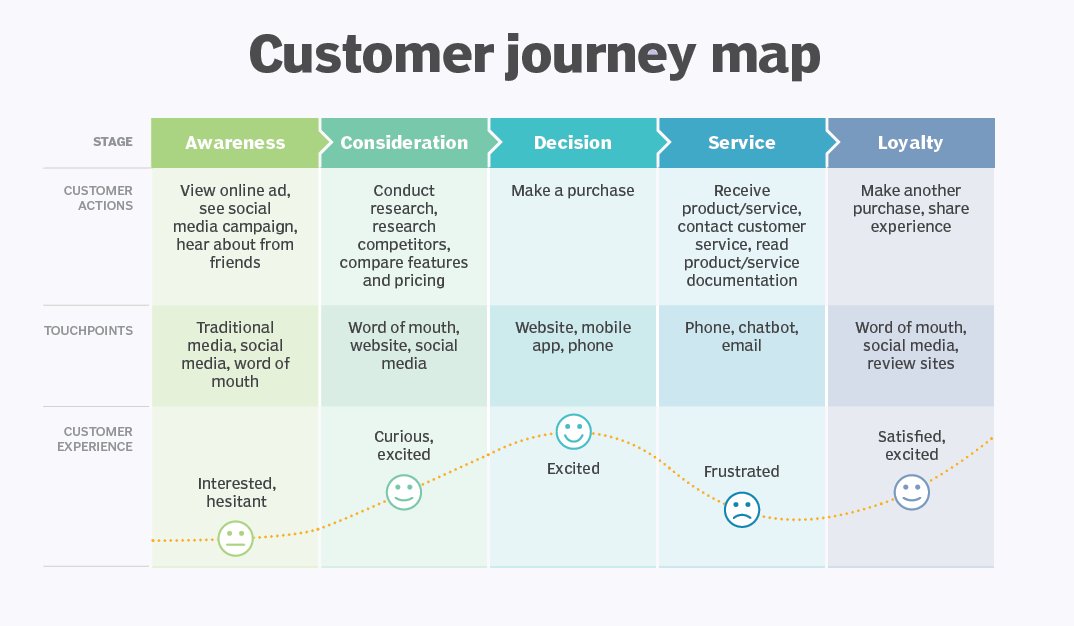
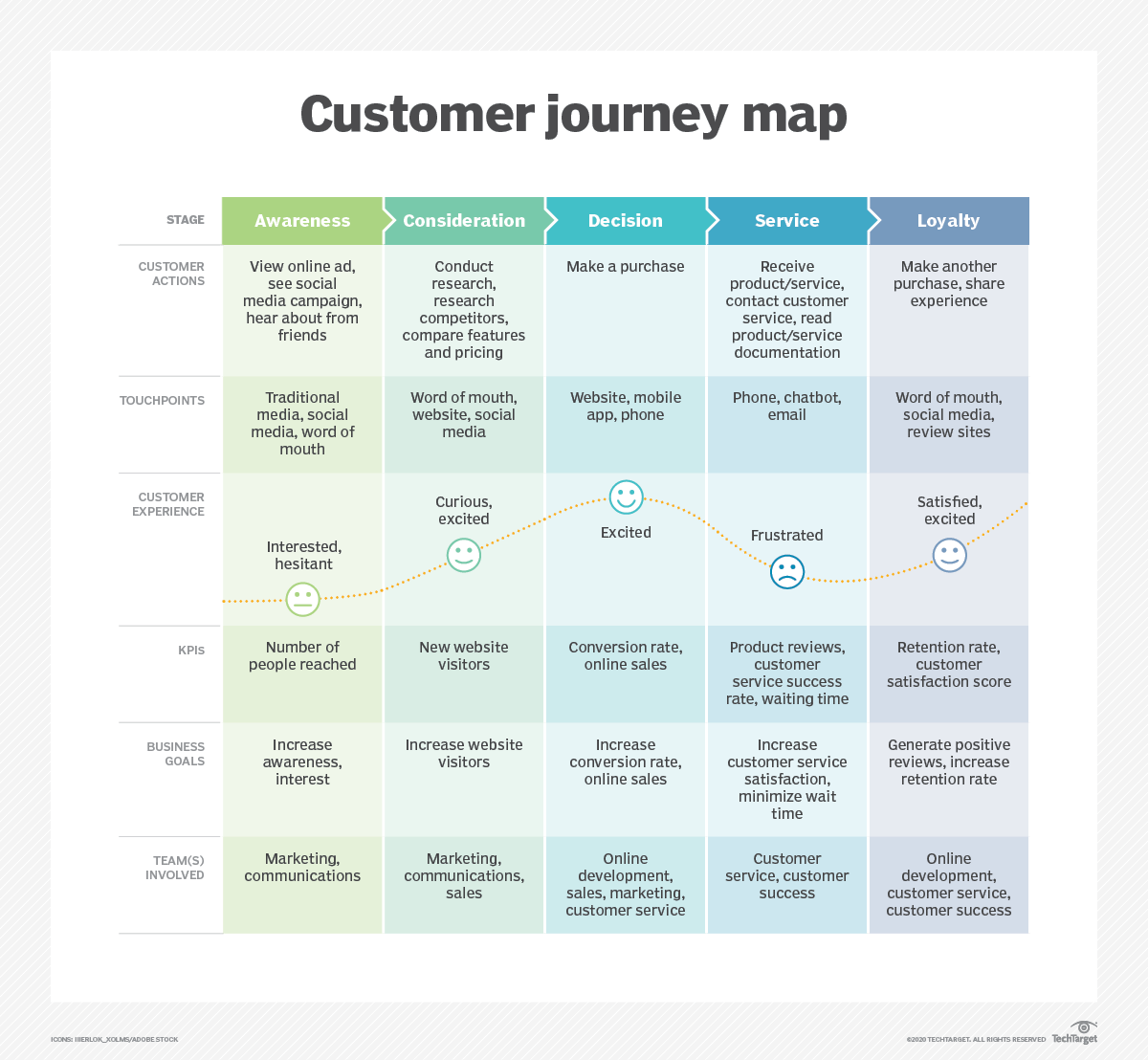
Through the information and insights on the Customer Journey Map, the company will know how to direct sales & marketing activities and product development, helping customers achieve their goals with the best experience.
Currently, there are many Customer Journey Map templates that you can easily find on the internet. Customer Journey Map also does not have a uniform template but is customized for each different product. In this article, ThinkZone will point out important steps and some principles to help you design a Customer Journey Map for your own product.
---
Subscribe Newsletter And agree to receive notifications on ThinkZone's website so you don't miss out on useful articles every week!
---
STEPS TO BUILD CUSTOMER JOURNEY MAP
Below we will go through 6 standard steps to build and use Customer Journey Map effectively.
1. Determine Customer Persona (Customer Persona)
To build a Customer Journey Map, you must first clearly understand who is the "passenger" on that journey. Customer Persona sketches the portrait of your target customer group, which is a prerequisite before you want to build a Customer Journey Map. Based on survey results and data obtained from current customers, Customer Persona provides a realistic and detailed view of customers such as their demographics, psychology, behavior, motivations, problems...

Clearly defining the Customer Persona will help you more clearly identify other content of the Customer Journey Map such as behavior, emotions, motivation,... throughout the product usage process.
2. Identify stages in the Customer Journey
The Customer Journey is often divided into 5 basic stages, which are: Awareness → Consideration → Purchase → Retention → Advocacy. In fact, the above steps may not follow each other, but overlap.
In addition, the stages in the Customer Journey Map also depend on the type of product (online or offline, website or app) and the company's target customer base. Therefore, the customer experience journey may not include the above basic steps, may be less, more, or it is a completely different journey.
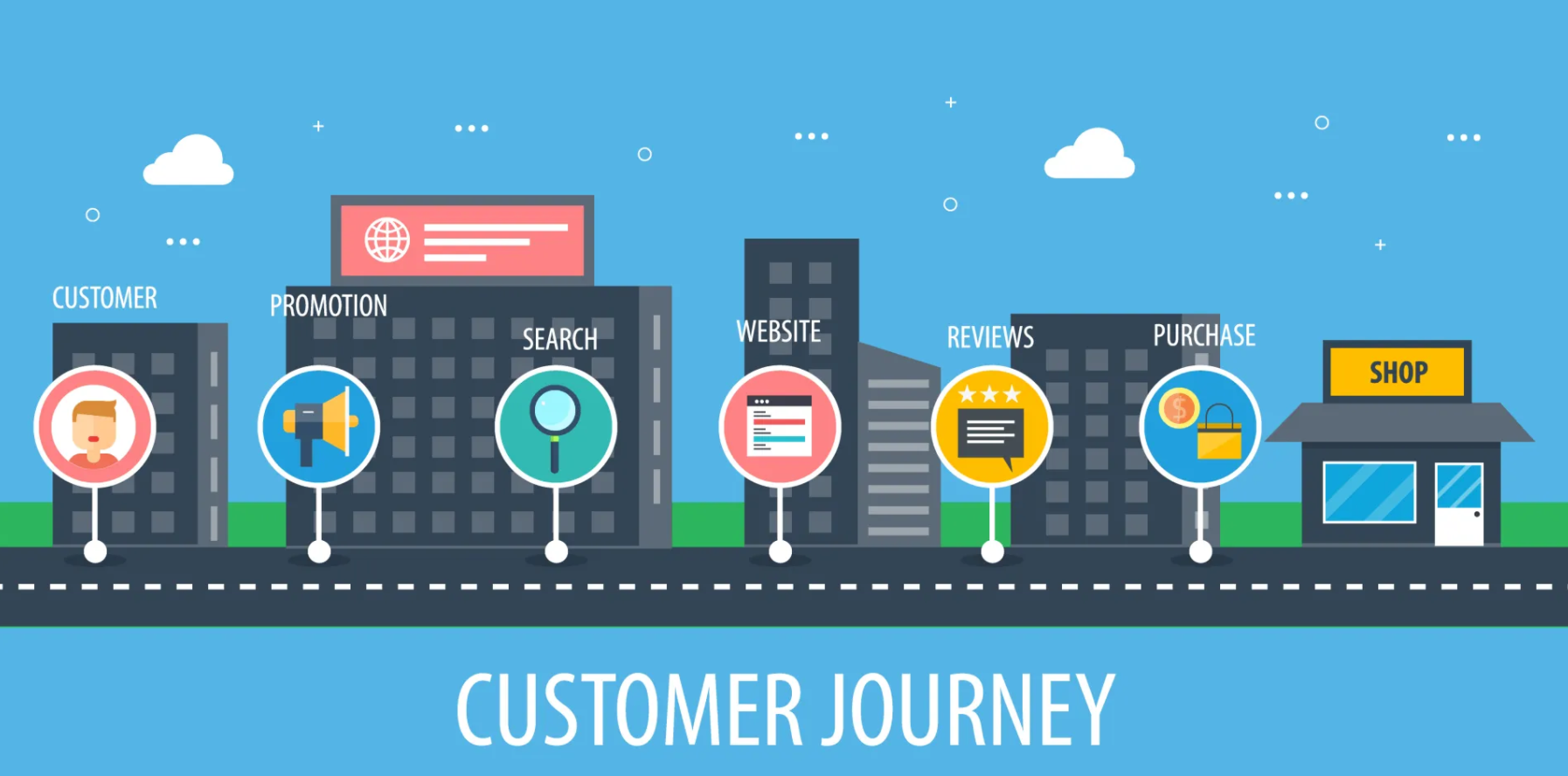
No matter what the product is, your task at this stage is to map out the steps in the customer's product usage journey, from first discovering the product, to using it, and introducing the product to acquaintances, etc. Outlining the full customer journey will help you have an overview and identify the Touchpoint with customers, thereby designing the best experience for them.
3. Identify Touchpoints with customers
Touchpoint is understood as the connection point between the brand and the customer (eg website, telesales staff, offline store,...). Analyzing customer behavior at Touchpoints will help the company provide many comments and insights about products and services.
For example, if the conversion rate is lower than average at a certain touchpoint, this means that the customer experience at that touchpoint is not good. (Maybe the website interface is not convenient, the payment steps are too complicated, the store location is not easy to find,...).

Every touch point between customers and products is a good opportunity for the company to promote its brand image and create a good experience for customers. A good customer experience is the sum of good experiences at many different touch points.
4. Customer feedback = Action + Emotion + Motivation
One of the main values of the Customer Journey Map is that you fully summarize the customer's actions and emotions throughout the Customer Journey, thereby having the clearest and most comprehensive view of the customer experience when using the product.
➤ Action: You list all the actions the customer takes during their interaction with the brand through the product or service. The action here can be as simple as their product search habits, what they do when they receive your email, how many steps it takes to pay for an order,...

The key here is to determine the number of actions needed at touch points for the customer to achieve their goals, and you find ways to (1) increase customer experience when performing those actions, and (2) improve products to cut out unnecessary actions, helping customers achieve their goals faster.
➤ Emotion & Motivation: All customer actions come from motivation and emotions, in which customers' emotions change depending on the problems/needs they arise at each time.
Clearly identifying customer emotions and motivations at each touch point will help companies offer the right content, features, and strategies at the right time to create the best experience for customers. To visualize, you can depict customer emotions on each stage through curves, or kinks. At each stage, you will drop an emotion icon from disappointment to satisfaction to make it easier to visualize.

This information is often collected from product analytics data (like Google Analytics, Mixpanel,...), customer interviews/surveys, customer care team, customer feedback via fanpage,...
5. Identify pain points that still exist on the Customer Journey
On the journey to conquer customers, companies need to identify and understand pain points (problem) that customers are experiencing, the "pain" when using the product causes the experience with the product to be affected. These pain points can be hard-to-find purchase buttons, complicated payment steps, long page load times, uncharitable sales staff,...
Pain points that customers encounter can be at any stage of the purchasing journey, and are often found at touchpoints where customer emotions are negative. (as determined in the step above).
6. Aggregate data and improve products
After completing the Customer Journey Map, your task is to identify the current pain points, select the major pain points and urgently improve the product and increase customer experience.
However, it should be noted that building a Customer Journey Map is not a one-time job but a long-term job, and is always improved and revised continuously during the product development journey. Periodically, perhaps every quarter or every 6 months, the Customer Journey Map will be reviewed, and the entire process above will be repeated so that the company continuously optimizes the product.

4 PRINCIPLES OF BUILDING EFFECTIVE CUSTOMER JOURNEY MAP
As mentioned, Customer Journey Map (CJM) There is no fixed template but can be built flexibly depending on the type of product, business model, customer base, etc. However, a Customer Journey Map needs to ensure the 4 principles below.
1. CJM is built from the customer's perspective, not the company's
The purpose of this map is to bridge the understanding gap between companies and users. If you stand from the perspective of the product maker, you will be biased and have difficulty understanding how most users are actually using the product. Therefore, the process of analyzing and building customer journey maps requires a lot of time and effort, mainly for analyzing user behavior data and interviews/surveys.
2. CJM represents the combination of customer experience and emotions
One of the most valuable points of customer journey maps is that they not only record customer actions, but also express their emotions and thoughts throughout the journey of using the product. This helps the company visualize the customer experience journey more vividly, providing many valuable insights to perfect the product.
3. CJM captures the omnichannel customer journey
The entire picture of journey maps will show how users approach the product through which touch points. Whether it's online or offline experience, interacting with products via email marketing or website, purchasing via computer or mobile app, texting with customer service staff via Zalo or Messenger,... those touch points all contribute importantly to creating a good or bad customer experience.
With a comprehensive perspective, CJM helps you not miss important touch points and interactions, ultimately finding ways to improve products/services and increase customer experience.
4. CJM visualizes the customer journey
CJM visualizes a concept that is not easy to visualize like customer experience into a map, with each specific touch point, each specific interaction, specific emotions, and a chart of the customer's mood throughout the product use process.
At the same time, CJM also shows the connection between the above factors (touch points, interactions, emotions, motivation,...), helping the team to communicate, present, and analyze the customer journey more easily, thereby detecting pain points and directions to improve the product more effectively.
SUMMARY
Above are 6 important steps and 4 principles to keep in mind to build an effective Customer Journey Map. Depending on the industry, target customers and purposes, the implementer will make adjustments and additions to the above steps to obtain a suitable and effective map. Furthermore, the process of building a Customer Journey Map is quite complicated and takes a lot of time, so carefully listen to your customers, and learn thoroughly about them.
Reference
https://blog.hubspot.com/service/customer-journey-map
https://www.hostgator.com/blog/what-are-touchpoints/
https://medium.com/choice-hacking/how-to-create-a-customer-journey-map-ffbd580284d7