
In this article, ThinkZone will go through the following contents in turn:
➤ Introduction to Churn Rate and its meaning
➤ How to calculate 2 important types of Churn Rate from simple to complex with specific examples
---
Subscribe Newsletter And agree to receive notifications on ThinkZone's website so you don't miss out on useful articles every week!
---
WHAT IS CHURN RATE?
Simply put, Churn Rate is a percentage that represents the level of user churn towards your product/service. And of course you will expect your Churn Rate to be as small as possible.
To be more specific, we have 2 important types of Churn Rate:
➤ Customer Churn Rate → Answer the question of how many users the business is losing (after a certain period of time).
➤ Revenue Churn Rate → Answer the question of how much MRR businesses are losing (Monthly Recurring Revenue) per month.
Each type of Churn Rate above is calculated based on a different perspective on customer churn behavior, bringing unique insights to businesses, and depending on each business model, businesses will evaluate these two indicators differently. How to calculate and evaluate various types of Churn Rate will be presented by ThinkZone in the following section.

WHAT DOES CHURN RATE SAY?
With the nature of showing the level of customer abandonment of a product/service, Churn Rate is one of the important indicators of every business. From Churn Rate, businesses can:
➤ Assess the "health of the business" and predict future business prospects
➤ Evaluate whether your product/service is creating value for users
➤ Through fluctuations in Chun Rate, identify changes in products that bring value to users
➤ Calculate Customer Lifetime Value (The specific calculation method will be introduced by ThinkZone in the following article)
➤ From Churn Rate by customer segment, determine the company's most potential customer group

In addition, Churn Rate also directly affects many other important indicators in the business:
➤ Monthly Recurring Revenue (MRR): If customers leave the product, it is likely that the business will also lose revenue. This is especially important for SaaS companies when MRR is the "lifeblood" ensuring the stable and long-term development of this business model. That's why SaaS companies always have a lower average Churn Rate than other business models.
➤ Customer Lifetime Value (CLTV): Also for the above reason, losing users means the company also loses revenue, causing revenue per user life cycle to also decrease.
➤ Customer Acquisition Cost (CAC): High Churn Rate means your product is not really good, and this also leads to a number of consequences: word-of-mouth communication decreases, businesses have to rely mainly on burning money to attract customers, causing CAC to increase.
HOW TO CALCULATE CHURN RATE PROPERLY?
In this section, we will go through how to calculate two important types of Churn Rate. Note that the Churn Rate calculation formulas are built from the definition introduced above, and each company may apply different calculation formulas, depending on their business model and products.
1. Revenue Churn Rate
We will start with Revenue Churn, an index that reflects the level of customer churn from a financial perspective.
As mentioned above, Revenue Churn Rate answers the question “How much MRR (Monthly Recurring Revenue) is your business losing each month?” Therefore, the formula for calculating Revenue Churn also comes directly from MRR.
Specifically, to calculate Revenue Churn Rate in month n, we take the amount of MRR the company lost in that month (due to cancellation or reduction of service packages) Subtract the additional MRR from upselling or increasing service packages from existing customers in month n, then divide by the MRR at the beginning of month n.

For example: Company A has $50,000 MRR (Monthly Recurring Revenue) at the beginning of October, by the end of the month there is $30,000 MRR left. In addition, in October, company A had some current customers upgrade their product packages, causing MRR to increase by $10,000. Then Revenue Churn = ($50,000 - $30,000 - $10,000)/ $50,000 = 20%.
* Note: Do not include revenue from new contracts in October in the formula, because your goal is to evaluate the churn level of current customers.
Revenue Churn Rate is especially used in B2B business models, especially B2B SaaS, in which revenue comes from large value contracts with businesses and the number of users fluctuates according to the number of contracts with companies. (so Customer Churn Rate does not play too big a role). According to Profitwell, The average Revenue Churn Rate of companies fluctuates from 2 - 16%, in which the higher the MRR the company has, the smaller the Revenue Churn Rate.

2. Customer Churn Rate
Customer Churn Rate looks at user behavior and answers the question “How many users is the business losing (over a certain period of time)?This index is especially important for B2C products, directly reflecting the quality of the product in the eyes of users.
There are many formulas for calculating Customer Churn Rate, from simple to complex, depending on how closely you want to look at this indicator. The more filters you add, the more complex the formula becomes, and of course, the more insights it brings.
Below are 3 formulas to calculate Customer Churn Rate according to Steve Noble, Data Specialist of Shopify.
2.1. Simple formula
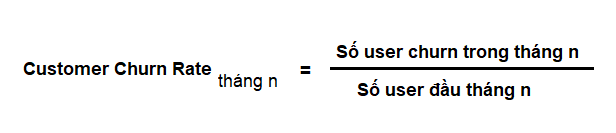
The simplest formula to calculate Customer Churn Rate in a month is to divide the number of users leaving that month by dividing the number of users at the beginning of the month.
Advantages and disadvantages
The advantage of this formula is its simplicity, when you only need two correct numbers: the number of users at the beginning of the month and the number of users at the end of the month to calculate.
However, the disadvantage of this formula is that Customer Churn Rate gradually reflects incorrectly the level of product churn as the product grows in users. Specifically, let's analyze the example below.

At the beginning of September, the company had 10,000 users, and an additional 5,000 users in September. By the end of the month, out of 10,000 users, 500 users (5%) canceled the service, and among the 5,000 new users, 125 users (2.5%) canceled the service. Thus, Customer Churn Rate in September is (500 + 125)/ 10,000 = 6.25%.
We keep the same assumptions about Existing Customer Churn and New Customer Churn for October and November, obtaining a Customer Churn Rate of 5.87% and 5.67% respectively.
Thus, although the churn behavior of current and new users does not change, customer churn gradually decreases as the number of users increases, making us mistakenly think that user churn behavior has decreased.
2.1. Adjusted formula
From the disadvantages of the simple formula, we come to the second formula, in which the denominator of the formula is adjusted to "neutralize" the user growth during the time period we are interested in, by taking the average of the number of users at the beginning and end of that period.

Advantages and disadvantages
This formula helps us "neutralize" user growth, making Customer Churn Rate no longer distorted when the number of users increases. Applying this formula to the example above, and adding the month November with the same assumptions about New Customer, Existing Customer Churn and New Customer Churn, we get:
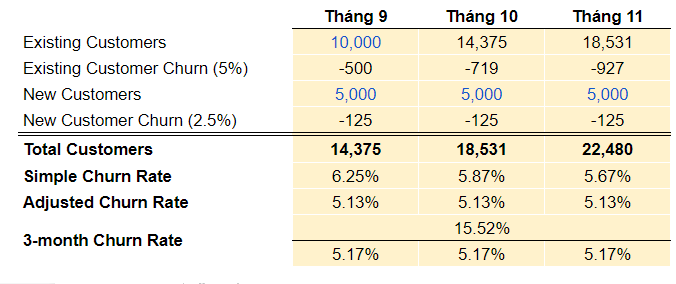
Customer Churn Rate for September is equal to (500 + 125)/ [(10,000 + 14,375)/ 2] = 5.13%. Similarly, the Customer Churn Rate for October and November are both 5.13%, as we would expect that when user churn behavior remains constant, the monthly Churn Rate also remains unchanged.
When calculating the Churn Rate of 3 months, we take the total number of customers leaving in 3 months and divide it by the average of customers in early September and late November, to get 15.52%, divided equally into each month, getting an average of 5.17%. Thus, if calculated on a quarterly basis, the Customer Churn Rate seems to be slightly different from the Churn Rate calculated on a monthly basis.
Adjusting the example a bit, let's say in September the company only had 120 new customers. With the same churn behavior, September's Adjusted Churn Rate was 5.13%. However, if calculated quarterly and divided equally into each month, the Churn rate of each month is only 4.58%.

This is also the disadvantage of the second formula, when the results of calculating Churn rate by month, quarter, or year will produce inconsistent Churn rate results. (For example, the total Churn rate of 3 months will be different from the Churn rate of the quarter). The results are even more skewed if the number of customers churning over time fluctuates a lot over time, as in the example above.
2.3. Formula applied by Shopify
Instead of just taking the average of the number of customers on the first and last days of the time period of interest, Shopify takes the average of the number of customers on all days in that period in the denominator of the Churn Rate calculation formula.

With this formula, whether n is 7, 30, 90 or 360, the problem in formula 2 will be solved. The downside is that the company will have to collect the number of customers every day.
Should I use a complex or simple formula?
The answer depends on the needs of each company. The simple formula may not produce very accurate results, but it also comes with the following advantages:
➤ Easy to remember, easy to understand, anyone in the company can understand the calculation and meaning, and with a key metric like Churn rate, this is a very important thing. Simply put, if people don't understand a metric, they won't know what to do with that number.
➤ Easy to compare: The more variables you add to the formula, the more things that can happen with those variables, and the harder it is for you to compare these metrics.
➤ Churn Rate is one of many key metrics for businesses. If you spend too much effort calculating this metric accurately, you will be distracted from other metrics.
SUMMARY
Above is an overview of the meaning and calculation of two important types of Churn Rate. Which formula to apply depends on the needs of each company, along with the characteristics of the product and business model. Continuously improving products/support services to reduce churn rate is extremely important for all types of businesses, and is especially important for SaaS businesses.
Reference
https://baremetrics.com/blog/revenue-churn#rev-vs-customer
https://www.salesforce.com/resources/articles/how-calculate-customer-churn-and-revenue-churn/
https://www.profitwell.com/customer-churn/calculate-churn-rate
https://www.profitwell.com/recur/all/average-revenue-churn-rate-benchmarks