In this article, ThinkZone will take you through each step of calculating Cap table, with Excel templates Specifically, it helps you visualize the Cap table calculation process to apply when calling for capital.
---
Subscribe Newsletter And agree to receive notifications on ThinkZone's website so you don't miss out on useful articles every week!
---
WHAT IS CAP TABLE?
As introduced above, Cap table is a table summarizing ownership shares (number and type of shares) of shareholders in a business. Shareholders here, besides founders, can also include employees, senior advisors, and investors.
The cap table of a business is a snapshot of the ownership structure of shareholders in that business, and changes over time.
When a startup is first established, the Cap table is very simple, only including shares of the founders, and maybe a few key employees. But gradually as the number of employees holding shares increased, senior advisors were added, and investors became shareholders, the shares held by members were gradually diluted, and the Cap table became more complicated.
If not careful, many businesses can still miscalculate the shares of each party in the Cap table, affecting the investment closing process.
HOW TO UPDATE CAP TABLE?
The enterprise's cap table is updated every time there is an adjustment in the share ownership structure of shareholders. In case of capital raising, the Cap table will be updated after the startup and investors finalize the Term sheet.
How to present the Cap table?
In the Cap table, you list the shareholders and the amount and type of shares they own. As a general rule, Cap tables group similar shareholders into groups.
For example, founders and key employees are often listed first, then VCs, then angel investors or small shareholders such as advisors, family, and friends. In the above groups, the Cap table also arranges shareholders in descending order of the number of shares they own.
A typical Cap table starts with a column of shareholders' names, then a column summarizing the shareholders' shares through each capital call round, and finally a column summarizing the shares of the parties. Funding periods can also be added if needed.
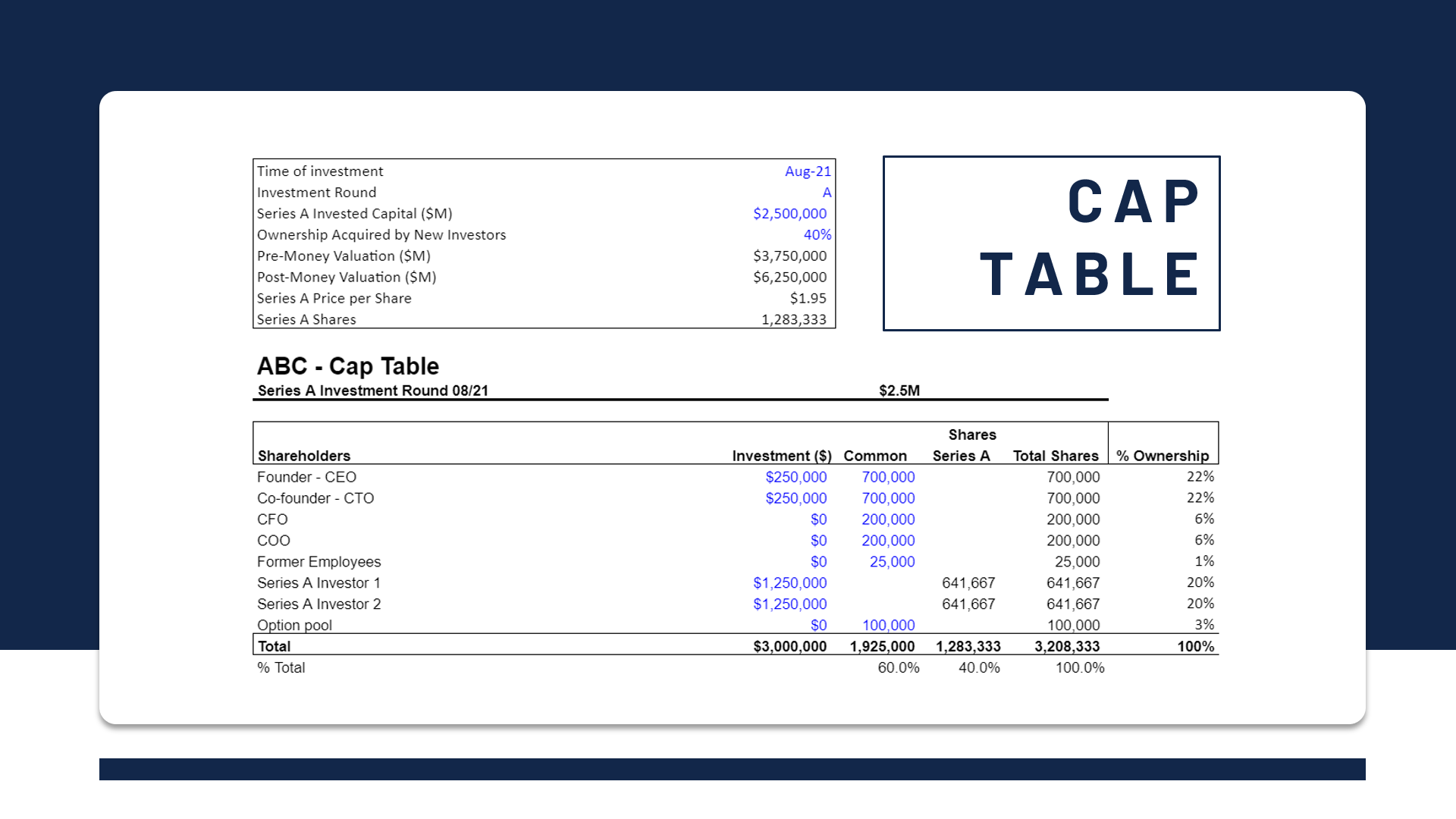
Below is an example of a typical Cap table.
The cap table typically aggregates the shares of the parties in the case fully-diluted, which includes all types of shares whether or not they have been granted to shareholders, such as option pools for future key employees, or shares that have not been fully vested for employees/co-founders.
➤ Read more about vesting in the article: Divide shares between co-founders appropriately?
What components need to be adjusted when updating the Cap table?
Some key components of the Cap table that can change when a startup calls for capital include:
➤ Company valuation and price per share (price per share)
➤ New investors and/or new types of shares (e.g. Series B Preferred shares)
➤ Shares for employees (if any)
➤ Debt converted into shares (applicable in case of convertible debt/ note)
Calculating dilution of Cap table through capital raising rounds
As the company grows, most of these changes are dilutive (dilutive), that is, shareholders' shares decrease when new investors are added. Dilution comes from the fact that companies often issue new shares when raising capital, which Shareholders' shares are the percentage of that shareholder's shares out of the total issued shares, so as the total number of shares issued increases, shareholders' shares decrease.
Although shares are gradually diluted, company valuations are often higher through capital raising rounds, called Up rounds. In the opposite case, we have the concept of Down round, which is something no company wants.
➤ Learn more about Down round and other investment concepts in the article: A term commonly used by Sharks and startups

Here is an example of an Up round case:
➤ Initially, the founder owned 100% of a valuation company $500,000.
➤ In the next round of capital raising, the company is valued 2 million USD, and investors want to own 40% share.
→ At that time, even though the founder's shares are diluted, the founder only has 60%, but the value he owns is 60% of 2 million USD, ie 1.2 million USD, much higher than the original $500,000.
How to calculate when updating Cap table?
Clearly, the total shares of shareholders in the Cap table must be 100%. When events occur such as calling for additional capital or converting debt into shares, all numbers in the Cap table must be updated while still ensuring the total shares are 100%.
To make it easier to imagine, let's go through the calculation steps to update the Cap table when the company calls for capital through a specific example. Readers download excel template here (blue data are entered data, black data are obtained from the formula).
Suppose ABC company is raising total Series A funding 2.5 million USD from 2 investors. Before receiving investment, ABC company's share structure is shown in the following table:

In which, the company's shares are held by 2 co-founders (each person holds 36%, contributed in total $500,000 into startups), and a number of key personnel. Quantity common shares (Common stocks) represents each person's shareholding in the company. At this time, the company has not conducted a valuation, so the number of shares only represents the ownership ratio, not the value that each person owns.
Options Pool is the amount of shares the company splits to reserve for issuance to key personnel in the future, in this case 100,000 shares not yet released.
After approaching, negotiating, appraising and finalizing the term sheet with Series A investors, includes Investor 1 and Investor 2, ABC company called successfully 2.5 million USD, and equity investors 40% shares. We will go through the calculation steps to update the Cap table.
-----
From the formula for calculating investors' shares:

With Investor's Equity = 40%, Investment = 2.5 million USD, we get Pre-money valuation of ABC is 3.75 million USD. And infer Post-money valuation = Pre-money valuation + Investment = 6.25 million USD.
When there is a new investor, the company will issue additional shares, representing the amount of shares that investor owns. We need to calculate the number of new shares the company needs to issue, based on value per share (Price per Share) and VC investment.
We have: Series A Price per Share = Pre-money valuation/ Outstanding share = $3,750,000/ 1,925,000 = $1.95 (Outstanding share is the amount of shares that the company has issued).
With Price per Share = $1.95 and an investment of 2.5 million USD, we can calculate the amount of shares that ABC needs to issue as 1,283,333 shares (= 2.5 mil/ 1.95), divided equally between investor 1 and investor 2.

After calculating the amount of new shares to be issued, the remaining job is to calculate the percentage of shares of each shareholder based on the total shares they hold through capital calls, and we get the results below.

We can see that the shares of co-founders and other shareholders have been diluted compared to before raising capital. Two co-founders, each only owner 22% company, but the value they own amounts to 1,375 million USD/ co-founder.
-----
Above is an example of a typical cap table. In fact, you can use this template for your first 1-2 rounds of funding, with simple investment terms.
However, as the number of investment rounds increases, more complex terms emerge such as when a shareholder resells shares to the next round of investors, when debt is converted into shares, or there are preferential buying rights with different Price per Share between investors,... The calculation steps will be more complicated and more confusing if calculating on Excel, and you will need stock management tools to manage the cap table effectively and avoid errors. (equity management tool, like Eqvista, Captable.io,...).
SUMMARY
Through the above article, you can visualize the function, basic elements, and how to calculate Cap table for simple capital calls. Remember to always update the Cap table every time the company has a change in the shareholder's share structure, and this is an extremely important thing that every investor will ask when you call for capital.