In the article below, ThinkZone will clearly explain 5 common questions and confusions that startups encounter about Design Thinking, thereby helping startups better understand and apply Design Thinking in their business processes.
-----
Sign up for ThinkZone's weekly newsletter to not miss the latest blog posts and investment news: https://bit.ly/TZNewsletter_web
-----
1. WHAT IS DESIGN THINKING?
In the simplest terms, Design Thinking is an iterative approach to solving problems creatively.
“Repetitive” This means that this process is continuously cyclical, not simply "do step 1 to step 5 and finish". These problems can be big or small, and can come from all aspects of the business.
And because it is a problem-solving process, Design Thinking can be applied not only to product development but also to many other processes, from building culture, internal team communication processes, to building partnerships and many business issues. Looking deeper, Design Thinking is one startup philosophy, a way of thinking and acting, not just a dry 5-step process.

In Design Thinking, we will seek to understand users/customers, and anyone else involved, thereby building assumptions about the pain users/customers encounter, thereby identifying important problems that need to be prioritized to solve, from there coming up with ideas and conducting continuous testing to choose the optimal solution.
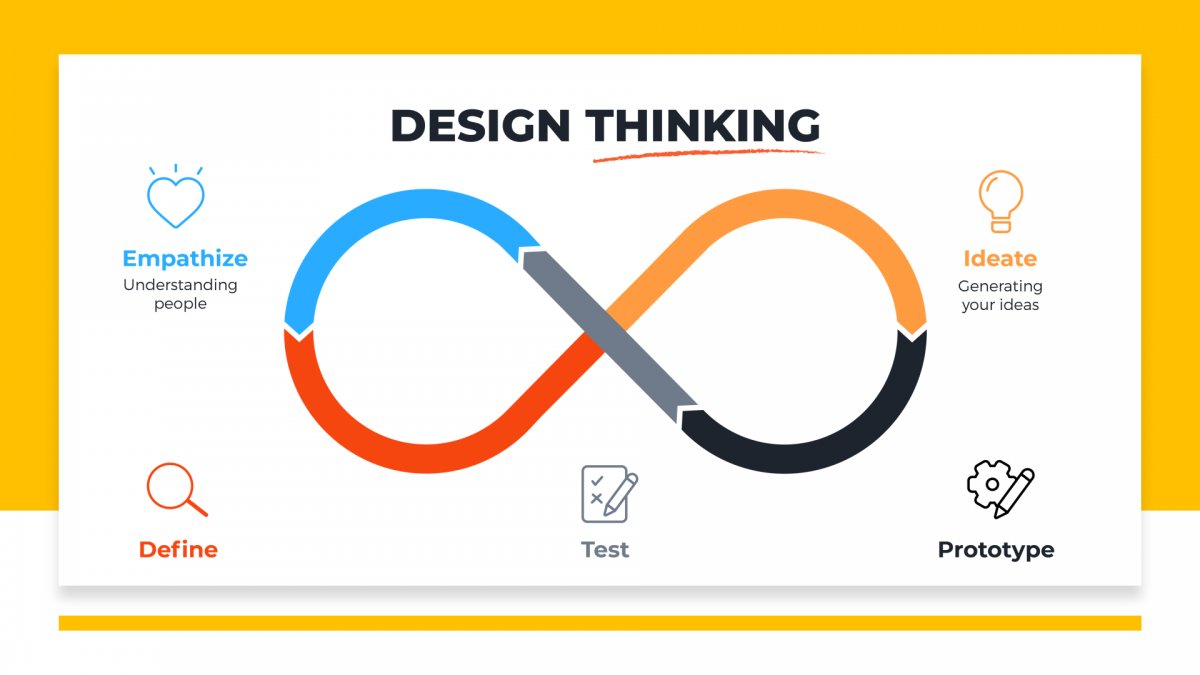
The Design Thinking process usually includes 5 main steps: Empathetic, Identify (problem), Come up with ideas, Build prototypes, Experiment.
--> Note: This is not a linear process, during the process of applying Design Thinking, you can completely go back to previous steps. For example, in process Come up with ideas, you can go back to the step Empathetic to consolidate understanding of users/customers and based on that to add new ideas. Or, in the process Experiment, you discover that your team's solution does not solve the problem customers/users are having, at this point you can go back to step 1. Come up with ideas to look for more feasible ideas, or go right back to the beginning Empathetic to ensure you have a deep understanding of the problem your users/customers are facing.
The steps of Design Thinking are based on two main principles: Empathetic and Experiment. Empathy means you put yourself in the user/customer's shoes to understand their feelings, thoughts, and problems they encounter. Experimentation means that based on your user/customer insights, you continuously test your ideas with them and continuously improve the solution based on user/customer feedback until you get the optimal solution.

2. WHAT IS THE DIFFERENCE BETWEEN DESIGN THINKING AND LEAN STARTUP?
Both methods have things in common, such as rapid testing and learning by doing. However, Lean Startup, from its name, indicates that it is a method applied in startups. Meanwhile, Design Thinking can be applied in many different contexts with different types of organizations. Although even large enterprises can apply the Lean Startup philosophy to their organization, it will still be more difficult than for startups due to differences in organizational size, number of stakeholders, and even internal political issues within the organization.
--> Lean Startup is more about process, while Design Thinking is more about attitude and thinking.
The "heart" of Lean Startup is the loop Build - Measure - Learn: Focus on construction Minimum Viable Product (MVP), measure key metrics and learn from the results. Meanwhile, Design Thinking does not focus on measuring, but on understanding, listening, and empathizing. In Design Thinking, you seek to understand; In Lean Startup, you seek to test assumptions.
Lean Startup and Design Thinking intersect in the process of building sample products and testing, you can see more visually with the chart below:

3. DO STARTUPS WHO HAVE A PRODUCT AND ARE IN THE PROCESS OF SCALE UP NEED TO USE DESIGN THINKING?
When founders first learn about Design Thinking, they think that this mindset is most suitable for people who just have ideas or are just starting to develop products. But in fact, Design Thinking is not only suitable for early-stage companies but is also used for many different stages in different organizations.
The word “Design Thinking” itself, in Vietnamese is “Design Thinking”, includes the word “thinking” in it. That means Design Thinking is a way of thinking – a way of approaching challenges within an organization.
Many people think that Design Thinking includes 5 steps, so it is automatically a linear process that always starts from step 1 – so it is only suitable for those who are just starting out with ideas. But as mentioned above, Design Thinking is a targeted non-linear, iterative process that helps teams bring users and other stakeholders into the product development process, to ensure that the final solution brings them the most value and best fits their needs.
To illustrate the diversity in application of this method, let's consider the following two cases:
Case 1: Startup is ready to scale
Let's say you're a startup that's been around for 3 years, you've achieved product-market fit with some good traction, and your goal in the next 6 months is to scale.
To scale, you will need more recurring revenue. This means you have to find ways to increase revenue from your current customers, or find more customers in the same segment, or maybe start targeting a new segment.

All of these options are quite challenging and contain many uncertain factors. Let's say you choose to earn more revenue from your existing customers. This is the time to use Design Thinking. To answer this question, you need to really understand your current customers: Why do they use your product/service? How often do they use it? What are the features they like most? What do they find inconvenient? What do they think could be improved? And what are they willing to pay more for?
Once you have returning customers and recurring revenue, you can assume you know your customers completely. But you will be surprised to know that many times customers or users use the product in completely different ways than the product team intended. Finding the answer and understanding exactly who your current customers are is key to figuring out how you can scale. The way you do that is of course through surveys, calls or customer interviews (Empathize). Once you gather enough information, you can identify opportunities to scale (Identify) and come up with a few options to test (Ideate). You can Build a prototype and Test a few ideas. Once you identify the best idea, you can focus all your efforts on developing the complete solution and achieving your growth goals.
Case 2: A large corporation is considering purchasing a new software
Suppose you are a large corporation with more than 1000 employees and you have just received an offer to use a new software to manage your operations: accounting, finance and information management. What will you do?
You can make this decision with your board based on a cost-benefit analysis, but here's the thing: Your employees will be the ones who will have to adapt and use this software, so why not take a moment to ask them what they think about the new software?
You can conduct a company-wide survey to understand how they use their current software, what they like, what they need and want to improve in their day-to-day operations (Empathize) so you can assess what their biggest needs are (Identify). That will give you more insight into whether you should buy that software or not. You can even Prototype it by asking for a 1-month trial and let your employees Test it to see if the new software is the right choice.
4. CAN DESIGN THINKING APPLY TO B2B STARTUPS?
Because much of the Design Thinking method and approach relies on empathy and understanding users, customers or stakeholders, many startup founders say: “But I have a B2B model, so I don't think I can use this model”.
This makes me feel really strange. Having a B2B model doesn't mean you're interacting with businesses in a dry way. Behind every business are people, they can be CEOs, sales staff, marketing staff... and you still need to understand their needs, goals and sympathize with them - the people who will make the decision to use your product or not.

Who makes the final decision? Who in that company do you need to pay attention to? Who in that target business will make the purchasing decision? --> Answering these questions requires the same approach you would in a B2C business.
In fact, understanding and identifying opportunities in B2B can be even easier than in B2C because you deal with fewer customers, you build longer-term relationships, and you have more one-on-one conversations that help you better identify areas for improvement.
5. DOES THE COMPANY NEED A MEMBER IN CHARGE OF DESIGN THINKING?
As mentioned above, Design Thinking is about attitude and approach to product development, so you don't need to hire an individual employee just to take responsibility for that. In fact, ThinkZone encourages every team member to equip themselves with this mindset and be able to apply it to their daily work. To do this, you might consider organizing an internal Design Thinking training session for employees, or encourage employees to learn and apply it on their own.
Do you have any other questions about Design Thinking that we haven't covered in this article? Or are you interested in having a Design Thinking training with your team? Don't hesitate to contact ThinkZone!